Showing posts with label mansion. Show all posts

Sunday, August 11, 2013

Oakley Park and the end of Carpetbag Rule in South Carolina


Oakley Park Museum in Edgefield, South Carolina
By 1876, the four year long War Between the States (or Civil War) had been over for 11 years, yet South Carolina - like most of the South - remained under the control of "radical Republican" carpetbaggers and their scalawag allies.

For those not familiar with the terminology of the day, the "radical Republicans" - a name they gave themselves - referred to a wing of the Republican party that favored punishment of Southerners for their role in the War Between the States as opposed to the peaceful reunion favored by Abraham Lincoln. Carpetbaggers were called such by Southerners because they were Northerners who came South after the war to seek their fortunes, often carrying their possessions in luggage made of carpet. Scalawags, also a term coined by Southerners, were Southern individuals who joined with and supported the Carpetbaggers.
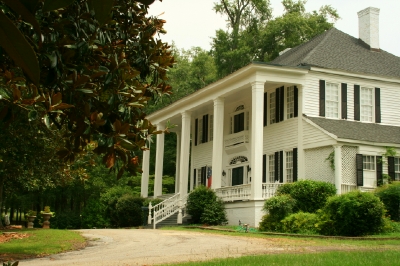
Oakley Park, Home of Gen. Martin W. Gary

While some of the individuals who came South after the war were well-intentioned, many were not and graft, corruption and brutal tactics were common during their decade of rule.

In South Carolina, as the election of 1876 approached, a movement grew among the state's Democrats to support former Confederate general Wade Hampton in the race for Governor. A victory by Hampton would break the backs of the radical Republicans and clear the way for a return of local rule to the Palmetto State.

Gary spoke from the balcony in 1876
Maj. Gen. Martin W. Gary, who lived at Oakley Park Mansion in Edgefield, was a key supporter of Hampton in that campaign. A general in the Hampton Legion during the war, Gary had refused to surrender at Appomattox Court House with Gen. Robert E. Lee. At the head of 200 horsemen from South Carolina, he broke through the encircling Union army and road south, eventually escorting President Jefferson Davis as far as South Carolina.

A fierce opponent of Reconstruction rule, Gary organized what became known as the "Red Shirt Campaign" to garner support for Hampton's gubernatorial campaign.

The "Red Shirts" were Democrats who donned red shirts and spread through the countryside to drum up support for Hampton. By election day, his movement had grown to include as many as 85,000 men and he spoke that day to 1,500 of them from the balcony at Oakley Park.

Thanks to the efforts of Gary and his Red Shirts, Hampton won the election and Reconstruction rule came to an end in South Carolina.

The general's home, Oakley Park, is now a museum that displays a rich collection of artifacts from both the War Between the States and Reconstruction.  To learn more, please visit www.exploresouthernhistory.com/oakleypark.

Thursday, July 12, 2012

Waverly - Mississippi's Haunted & Historic Mansion

Waverly Mansion
An architectural wonder, Waverly Mansion was once the center of a vast Mississippi cotton plantation. Still a private residence, the home is open to the public daily and is located between the Mississippi cities of Columbus and West Point.
Designed during the 1840s, the house took several years to construct and was finished in 1852. The octagonal cupola, its distinguishing architectural feature, offered Col. George Hampton Young a 360 degree view of his plantation and the surrounding countryside. It also was part of a unique 19th century "air conditioning" system.

The Gates of Waverly
The interior of the house is open from the cupola down to the ground floor and when the windows are open, it generates airflow that moves warmer air up and out of the cupola as cooler air flows in through the downstairs window. The resulting "breeze" helped cool the house during the hot Mississippi summer and was a remarkable innovation for its day.

Waverly also had interior lighting powered by gas manufactured on the grounds and then piped into the house. An exterior ice house was dug 20 feet deep and provided storage for blocks of ice brought in from Northern climes. The natural insulation provided by storing the ice so far underground helped keep it from melting for weeks at the time and allowed the residents and their guests to enjoy chilled beverages.

The home's original owner, Col. Young was a friend of Confederate general Nathan Bedford Forrest and the "Wizard of the Saddle" once spent three weeks at Waverly recuperating from battlefield wounds.

And then their are the ghosts! The 20th century restoration of Waverly apparently awakened quite a collection of them, ranging from a young girl who cries for her mother to a mysterious horse and rider that appear in the yard. Waverly is traditionally said to be one of the most haunted houses in the South.

To learn more, please visit www.exploresouthernhistory.com/waverly.