Showing posts with label edgefield. Show all posts

Sunday, August 11, 2013

Oakley Park and the end of Carpetbag Rule in South Carolina


Oakley Park Museum in Edgefield, South Carolina
By 1876, the four year long War Between the States (or Civil War) had been over for 11 years, yet South Carolina - like most of the South - remained under the control of "radical Republican" carpetbaggers and their scalawag allies.

For those not familiar with the terminology of the day, the "radical Republicans" - a name they gave themselves - referred to a wing of the Republican party that favored punishment of Southerners for their role in the War Between the States as opposed to the peaceful reunion favored by Abraham Lincoln. Carpetbaggers were called such by Southerners because they were Northerners who came South after the war to seek their fortunes, often carrying their possessions in luggage made of carpet. Scalawags, also a term coined by Southerners, were Southern individuals who joined with and supported the Carpetbaggers.
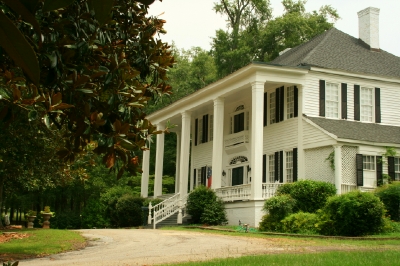
Oakley Park, Home of Gen. Martin W. Gary

While some of the individuals who came South after the war were well-intentioned, many were not and graft, corruption and brutal tactics were common during their decade of rule.

In South Carolina, as the election of 1876 approached, a movement grew among the state's Democrats to support former Confederate general Wade Hampton in the race for Governor. A victory by Hampton would break the backs of the radical Republicans and clear the way for a return of local rule to the Palmetto State.

Gary spoke from the balcony in 1876
Maj. Gen. Martin W. Gary, who lived at Oakley Park Mansion in Edgefield, was a key supporter of Hampton in that campaign. A general in the Hampton Legion during the war, Gary had refused to surrender at Appomattox Court House with Gen. Robert E. Lee. At the head of 200 horsemen from South Carolina, he broke through the encircling Union army and road south, eventually escorting President Jefferson Davis as far as South Carolina.

A fierce opponent of Reconstruction rule, Gary organized what became known as the "Red Shirt Campaign" to garner support for Hampton's gubernatorial campaign.

The "Red Shirts" were Democrats who donned red shirts and spread through the countryside to drum up support for Hampton. By election day, his movement had grown to include as many as 85,000 men and he spoke that day to 1,500 of them from the balcony at Oakley Park.

Thanks to the efforts of Gary and his Red Shirts, Hampton won the election and Reconstruction rule came to an end in South Carolina.

The general's home, Oakley Park, is now a museum that displays a rich collection of artifacts from both the War Between the States and Reconstruction.  To learn more, please visit www.exploresouthernhistory.com/oakleypark.

Tuesday, October 30, 2012

10 Great Ghost Stories of the South!

Recent Photo of the Ghost of Bellamy Bridge
With Halloween just one day away, I thought it would be a great time to share this year's list of 10 Great Ghost Stories of the South!  So, here we go...

  1. The Ghost of Bellamy Bridge (Marianna, Florida) - This is a great story that originated in the 1800s and preserves the tragic tale of an unfortunate young woman who is said to haunt the environs of one of Florida's oldest bridges.  Learn more at www.exploresouthernhistory.com/bellamybridge.
  2. The Face in the Window (Carrollton, Alabama) - The face of a terrified man can be seen in the window of the old Pickens County Courthouse in Carrollton. www.exploresouthernhistory.com/faceinthewindow.
  3. The Edgefield Ghost (Greenwood County, South Carolina) - This early 19th century haunting was one of the most noteworthy in American history and was witnessed by hundreds of people including ministers and reporters!  Learn more at www.exploresouthernhistory.com/edgefieldghost.
  4. The Bell Witch (Adams County, Tennessee) - Possibly America's most famous haunting, the Bell Witch incident supposedly took place in Adams County, Tennessee.  Learn more at: www.exploresouthernhistory.com/bellwitch1.
  5. The Crescent Hotel (Eureka Springs, Arkansas) - The Crescent Hotel bills itself as America's most haunted hotel, and with good reason! Learn more at www.exploresouthernhistory.com/crescenthotel.
  6. The Ghost of Big Cedar (near Branson, Missouri) - Big Cedar Resort just south of Branson is said to be haunted by the wife of one of its original owners!  This is one of the most famous ghosts of the Ozarks.  Learn more at www.exploresouthernhistory.com/bigcedar1.
  7. Ghosts of the St. Augustine Lighthouse (St. Augustine, Florida) - One of Florida's most intriguing ghost stories, the tale of the strange figures in the St. Augustine Lighthouse has attracted attention for years. Learn more at www.exploresouthernhistory.com/staugustinelighthouse.
  8. Ghost of Allatoona Pass (Bartow County, Georgia) - This ghost used to catch rides on trains along the old railroad leading north from Atlanta!  Please click here to learn more: www.exploresouthernhistory.com/allatoonaghost.
  9. Ghosts of Waverly Mansion (West Point, Mississippi) - Waverly Mansion near West Point is said to be one of the most haunted places in Mississippi.  Please click here to learn more: www.exploresouthernhistory.com/waverly
  10. Ghost of St. Simons Lighthouse (St. Simons Island, Georgia) - The unhappy spirit of a former lighthouse employee is said to haunt the beautiful old tower of the St. Simons Lighthouse.  Please click here to learn more http://www.exploresouthernhistory.com/gastsimons2.html.

Monday, October 18, 2010

The Edgefield Ghost - A Poltergeist in Antebellum South Carolina

Ghost stories abound in the South, but few are as well documented as an incident that took place in the Edgefield District of South Carolina in 1829. It was known at the time as the Edgefield Ghost.

The strange encounter took place in the home of Isaac Burnett and began as strange sounds heard in and around the house, but gradually escalated to what newspapers of the time described as a full blown paranormal encounter. The ghost was not seen, but would routinely talk, answer questions and even whistle songs. Word of the haunting quickly spread through the Edgefield District and scores of other individuals came to see it for themselves. The ghost, or whatever it was, obliged, talking to everyone from neighbors to an old time fire and brimstone Baptist preacher.

The Edgefield Ghost was widely documented in letters and newspapers of the time and continued to be mentioned by editors for decades to come.

The site of the haunting, which gradually faded away in the 1830s, is now in Greenwood County, South Carolina, roughly between the cities of Edgefield and Greenwood. The Burnett house is long gone, as are all traces of the old farm, with only woods and overgrown fields marking the site.

To learn the full story of this remarkable event, please visit www.exploresouthernhistory.com/edgefieldghost.

Tuesday, October 21, 2008

Southern Ghosts Part Ten - The Edgefield Ghost, South Carolina

One of the most fascinating ghost stories in American history developed in Edgefield, South Carolina, in 1829 and was widely reported in U.S. newspapers of that year.

The following is the initial report from the Edgefield Courier newspaper of July 11, 1829:

A public curiosity has been greatly excited, and many tales more or less true, have gone out, concerning the mysterious and invisible being, that has been heard at Mr. Isaac Burnett's, in this District, for some time, it seems proper that the Public should be in possession of the facts relative to this extraordinary circumstance. The voice was first heard in October last, imitating various noises, such as that of th espinning wheel, reel ducks, hens, & c. It was first heard by Mr. Burnett, about twenty yards from the house, which led him to suppose it was some of the neighbor's children, hiding in the weeds and trying to frighten his children. It was afterwards heard in the loft of the house and Mr. B. supposing it to be a bird, sent a boy up to drive it out, but nothing could be seen. It thus continued to perplex the minds of the family for some time, until, at length, one of the children said he believed that thing could talk, and commenced asking questions, which it answered by whistling, pretty much like a Parrot. This circumstance getting out, many persons came to hear it. Mr. John Shepherd, a...worthy citizen, who lives in the neighborhood, conversed with it in presence of a nuber of witnesses. To ascertain the extent of its knowledge, he asked it various questions about most persons in the neighborhood and their circumstances which it answered correctly. It told his name and the number of children he had; also, the names of most of the persons present. He asked what it came there for. It replied, "Because it had no other place to go." It was asked if it came to do the family harm, it said no - it loved the family. It was asked finally if it loved Jesus Christ, to which it made no reply, nor answered any more question, which Mr. Shepherd asked. The evening after, it answered others, but would not answer him. For the first three months it was heard only once a month....

The Edgefield ghost continued to draw considerable attention in newspapers through 1829 and 1830, but coverage of the strange spirit finally diminished. Accounts indicate, however, that numerous people heard and conversed with it in 1829 and that it was sometimes heard whistling "Yankee Doodle."