Showing posts with label appomattox. Show all posts

Sunday, August 11, 2013

Oakley Park and the end of Carpetbag Rule in South Carolina


Oakley Park Museum in Edgefield, South Carolina
By 1876, the four year long War Between the States (or Civil War) had been over for 11 years, yet South Carolina - like most of the South - remained under the control of "radical Republican" carpetbaggers and their scalawag allies.

For those not familiar with the terminology of the day, the "radical Republicans" - a name they gave themselves - referred to a wing of the Republican party that favored punishment of Southerners for their role in the War Between the States as opposed to the peaceful reunion favored by Abraham Lincoln. Carpetbaggers were called such by Southerners because they were Northerners who came South after the war to seek their fortunes, often carrying their possessions in luggage made of carpet. Scalawags, also a term coined by Southerners, were Southern individuals who joined with and supported the Carpetbaggers.
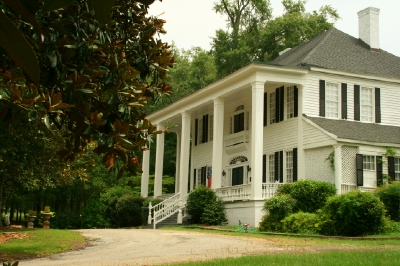
Oakley Park, Home of Gen. Martin W. Gary

While some of the individuals who came South after the war were well-intentioned, many were not and graft, corruption and brutal tactics were common during their decade of rule.

In South Carolina, as the election of 1876 approached, a movement grew among the state's Democrats to support former Confederate general Wade Hampton in the race for Governor. A victory by Hampton would break the backs of the radical Republicans and clear the way for a return of local rule to the Palmetto State.

Gary spoke from the balcony in 1876
Maj. Gen. Martin W. Gary, who lived at Oakley Park Mansion in Edgefield, was a key supporter of Hampton in that campaign. A general in the Hampton Legion during the war, Gary had refused to surrender at Appomattox Court House with Gen. Robert E. Lee. At the head of 200 horsemen from South Carolina, he broke through the encircling Union army and road south, eventually escorting President Jefferson Davis as far as South Carolina.

A fierce opponent of Reconstruction rule, Gary organized what became known as the "Red Shirt Campaign" to garner support for Hampton's gubernatorial campaign.

The "Red Shirts" were Democrats who donned red shirts and spread through the countryside to drum up support for Hampton. By election day, his movement had grown to include as many as 85,000 men and he spoke that day to 1,500 of them from the balcony at Oakley Park.

Thanks to the efforts of Gary and his Red Shirts, Hampton won the election and Reconstruction rule came to an end in South Carolina.

The general's home, Oakley Park, is now a museum that displays a rich collection of artifacts from both the War Between the States and Reconstruction.  To learn more, please visit www.exploresouthernhistory.com/oakleypark.

Friday, March 26, 2010

Appomattox Court House National Historical Park - Appomattox, Virginia

While the surrender of General Robert E. Lee and the Army of Northern Virginia at Appomattox Court House did not end the Civil War, it did start the final collapse of the Confederate cause.

The sites where Lee's army fought its last battle and where he met Union General Ulysses S. Grant to surrender are now preserved as part of Appomattox Court House National Historical Park. Located two miles outside Appomattox, Virginia, the park preserves the historic town of Appomattox Court House where the closing scenes of the war in Virginia took place.

Retreating south across the Virginia countryside, Lee reached Appomattox Court House on the afternoon of April 8, 1865. Grant's forces had forced the Confederates to evacuate their positions at Petersburg, a withdrawal that forced President Jefferson Davis and the Southern government to flee the capital of Richmond. As Lee retreated, Grant pursued him with relentless tenacity. By the time the Confederate general reached Appomattox, key parts of his army had already been cut off and captured.

As his army camped in the fields and pastures around the little town of Appomattox Court House on the night of April 8th, Lee knew he was surrounded but thought that only cavalry was in the vicinity. He ordered General John B. Gordon to attack at dawn on the 9th, believing that he could cut his way through and open a way for the army to reach supplies and rail transportation. His plan was to form a junction with General Joseph E. Johnston's army in North Carolina and continue the war.

The attack took place as planned and Gordon drove through two lines of Union cavalry to capture an important ridge. Once there, however, he could see two corps of Grant's infantry forming for action. He informed Lee that there was nothing more he could do.

The realization that he could not break through hit the Confederate commander hard and he told his generals and staff that nothing remained for him to do but to go meet with General Grant. "I would rather die a thousand deaths," he said.

The two met at the Wilmer McLean house in Appomattox Court House that afternoon and Lee surrendered the Army of Northern Virginia. The move started the full collapse of the Confederate military effort.

To learn more about Appomattox Courthouse, please visit www.exploresouthernhistory.com/appomattox.