Showing posts with label sequoyah. Show all posts

Thursday, March 27, 2014

Bicentennial of the Battle of Horseshoe Bend, Alabama

Horseshoe Bend National Military Park
The Battle of Horseshoe Bend was fought 200 years ago today in the Creek Nation of Alabama. The outcome forever changed the history of the United States.

The Creek War of 1813-1814 had been underway for more than nine months when Major General Andrew Jackson left Fort Williams near present-day Sylacauga with an army of 3,300 men. The general and his men arrived within six miles of the Horseshoe Bend of the Tallapoosa River on the evening of March 26, 1814.

Tallapoosa River at Horseshoe Bend
The next morning Jackson sent Brigadier General John Coffee with a force of 1,300 men to cross the Tallapoosa and surround the bend from its opposite shore. He then moved forward with the rest of his army and sealed off the neck of the peninsula. Receiving word that Coffee was in place to cut off any attempt at retreat by the Red Stick Creek army, Jackson began his attack at 10:30 in the morning, 200 years ago today.

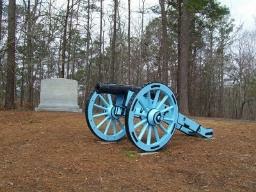
U.S. artillerymen manhandled two cannon - a 3-pounder and a 6-pounder - to the top of a hill overlooking the massive fortification that the Creeks had built to defend their town of Tohopeka ("Horse's Flat Foot"), a village that took its name from the unusual shape of the Horseshoe Bend. As Jackson's troops formed into lines of battle facing the barricades, the gun crews opened fire.

Site of the Creek fortification
For two hours the guns blasted away at the Red Stick defenses, but the solid iron cannonballs either ricocheted off the solid wall or flew over it. At noon, however, General Coffee's blocking force changed the course of the battle.

Among the 1,300 men assigned to Coffee were 600 Cherokee and Creek warriors who had allied themselves with the United States. With the battle in doubt, the Cherokee soldiers swam the river and launched an attack on the rear of the Red Stick line. The famed scholar Sequoyah was part of this attacking force.

Grave of Major Lemuel Montgomery
Facing attack from both directions, the Red Sticks had no choice but to divide their army. The main body of their warriors remained behind the wall to oppose Jackson while a smaller force rushed to the rear to battle Coffee's oncoming warriors. Seizing the moment, General Jackson ordered his infantry to attack.

Surging forward, the 39th U.S. Infantry struck the Creek fortifications. Major Lemuel Montgomery was killed and Ensign Sam Houston (later President of Texas) was severely wounded, but the 39th went up and over the wall. Jackson's Tennessee militia troops followed.

Menawa
Led by the war chief Menawa, the Red Sticks continued to fight. For hours the sounds of gunfire, screams and war cries echoed through the smoke that covered the Horseshoe Bend. A couple of hundred Red Sticks tried to escape by swimming the Tallapoosa, but Coffee and his riflemen shot them in the water. So many were slain that the river ran red with blood. Almost all of Menawa's other warriors fought to the death.

When night fell, the severely wounded war chief crawled out from under a pile of bodies and slipped away. He was disfigured for life. A few of his warriors also managed to swim away, but the Creek Nation would never recover from the devastating defeat.

Andrew Jackson
Jackson and his men counted the dead the following day by cutting off the noses of Menawa's slain warriors and then doing a "nose count." The bodies of 557 Red Stick warriors were found on the battlefield and Coffee estimated that another 200-300 were slain in the river. The bones of the dead littered the scene for years to come.

U.S. losses in the battle were 49 killed and 157 wounded. Many of the latter died in the days, weeks and months that followed.

The Battle of Horseshoe Bend did not end the Creek War of 1813-1814, but its outcome was never in doubt after March 27, 1814. The engagement started Andrew Jackson on his road to the White House and the Creek Nation on its journey to the Trail of Tears.

Five months later, the United States forced the Creeks to sign the Treaty of Fort Jackson. The document exacted severe terms on Red Stick and U.S. allied chiefs alike, forcing the cession of 23 million acres of Creek land to the United States.

To learn more about the Battle of Horseshoe Bend, please visit www.exploresouthernhistory.com/AlabamaHSB.

To learn more about the Creek War of 1813-1814, please visit www.exploresouthernhistory.com/creekwar.

To learn more about the Creek Trail of Tears, please visit www.exploresouthernhistory.com/creektrail.


Wednesday, January 7, 2009

Sequoyah's Cabin - Sallisaw, Oklahoma


I've devoted some attention over the last couple of days to the remarkable story of Sequoyah, one of the greatest scholars of the 19th century. Sequoyah, as we've discussed, was the man who invented the Cherokee Alphabet, the only written language ever developed by a Native American tribe.

If you are interested in learning more about the real life of this phenomenal man, one of the best places to do so is at Sequoyah's Cabin, a truly beautiful historic site just north of Sallisaw, Oklahoma.

Maintained by the Oklahoma Historical Society, the site preserves the little log cabin where Sequoyah spent the last two decades of his life. In addition, on the grounds are the iron kettle that he once used to make salt, a stone-walled well that he built, a very nice statue and a visitor center built from logs cut and dressed in part by Sequoyah himself.
The cabin itself is beautifully restored and is housed inside a memorial building built during the Great Depression.

To learn more, please visit www.exploresouthernhistory.com/sequoyah1.


Tuesday, January 6, 2009

Sequoyah and the Cherokee Alphabet


One of the most significant scholarly accomplishments of the 19th century was achieved by a disabled Cherokee warrior working quietly in a crude log cabin near the present city of Fort Payne, Alabama.

Sequoyah, also known by the "white" name of George Gist or Guess, had located to Wills Town, a major Cherokee settlement in Alabama, in 1818. Born in Tennessee in around 1770, he had served with U.S. allied Cherokee forces under Andrew Jackson at the Battle of Horseshoe Bend, Alabama, in 1814.

In the years following the Battle of Horseshoe Bend, Sequoyah became convinced that the reason white civilization was advancing much more rapidly than that of the various Native American tribes was because the whites had developed a way of communication with each other in writing.

The more he thought about the possibilities of a written Cherokee language, the more Sequoyah decided to make the development of one a personal quest. Despite ridicule from family and friends, he began work on the project. It would take years to complete.

In 1821, however, Sequoyah successfully demonstrated his Cherokee Alphabet. Over the next few years leaders in the nation became convinced of the remarkable nature of his effort and the use of the written Cherokee language spread like wildfire. In 1825 the Cherokee became the first Native American nation to publish their own newspaper in their own language. Sequoyah's alphabet had become the first official written language in Indian history.

To learn more about Sequoyah and his remarkable alphabet, please visit our new Sequoyah pages at www.exploresouthernhistory.com/sequoyah.


Monday, January 5, 2009

Wills Town Mission - A Cherokee Cemetery in Alabama


One of the most fascinating historic sites I've visited in a long, long time can be found on the outskirts of Fort Payne, Alabama.

Wills Town Mission, a Christian mission to the Cherokee Indians that operated from 1823 until the Trail of Tears in 1838, is marked today by a unique cemetery on 38th Street just south of its intersection with Godfrey Avenue in Fort Payne. First used by the Cherokee inhabitants of Wills Town, a major Native American village, the cemetery was later used by 19th century white settlers as well.

The Cherokee graves are marked by natural stones, some of which exhibit faded symbols and carvings, and the stumps of cedar trees. It is reported locally that the trees were cut years ago for building materials by a previous owner of the site. The cemetery is now preserved and marked by a historical marker and a stone monument.

Wills Town was a significant settlement among the Cherokee of Alabama prior to the Trail of Tears. It was in the vicinity that Sequoyah completed his development of the Cherokee alphabet in 1821, giving the Cherokee Nation the only written language of any Native American nation.

The Christian mission in the town converted many members of the tribe to Christianity and also provided education in English, etc., to the inhabitants of Wills Town. The people of the village, however, were among those forced west under the guns of soldiers on the long and deadly march remembered today as the Trail of Tears.

To learn more about Wills Town and its unique Cherokee cemetery, please visit www.exploresouthernhistory.com/fortpayne2.