Showing posts with label andrew jackson. Show all posts

Thursday, March 27, 2014

Bicentennial of the Battle of Horseshoe Bend, Alabama

Horseshoe Bend National Military Park
The Battle of Horseshoe Bend was fought 200 years ago today in the Creek Nation of Alabama. The outcome forever changed the history of the United States.

The Creek War of 1813-1814 had been underway for more than nine months when Major General Andrew Jackson left Fort Williams near present-day Sylacauga with an army of 3,300 men. The general and his men arrived within six miles of the Horseshoe Bend of the Tallapoosa River on the evening of March 26, 1814.

Tallapoosa River at Horseshoe Bend
The next morning Jackson sent Brigadier General John Coffee with a force of 1,300 men to cross the Tallapoosa and surround the bend from its opposite shore. He then moved forward with the rest of his army and sealed off the neck of the peninsula. Receiving word that Coffee was in place to cut off any attempt at retreat by the Red Stick Creek army, Jackson began his attack at 10:30 in the morning, 200 years ago today.

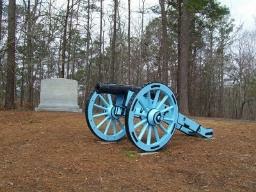
U.S. artillerymen manhandled two cannon - a 3-pounder and a 6-pounder - to the top of a hill overlooking the massive fortification that the Creeks had built to defend their town of Tohopeka ("Horse's Flat Foot"), a village that took its name from the unusual shape of the Horseshoe Bend. As Jackson's troops formed into lines of battle facing the barricades, the gun crews opened fire.

Site of the Creek fortification
For two hours the guns blasted away at the Red Stick defenses, but the solid iron cannonballs either ricocheted off the solid wall or flew over it. At noon, however, General Coffee's blocking force changed the course of the battle.

Among the 1,300 men assigned to Coffee were 600 Cherokee and Creek warriors who had allied themselves with the United States. With the battle in doubt, the Cherokee soldiers swam the river and launched an attack on the rear of the Red Stick line. The famed scholar Sequoyah was part of this attacking force.

Grave of Major Lemuel Montgomery
Facing attack from both directions, the Red Sticks had no choice but to divide their army. The main body of their warriors remained behind the wall to oppose Jackson while a smaller force rushed to the rear to battle Coffee's oncoming warriors. Seizing the moment, General Jackson ordered his infantry to attack.

Surging forward, the 39th U.S. Infantry struck the Creek fortifications. Major Lemuel Montgomery was killed and Ensign Sam Houston (later President of Texas) was severely wounded, but the 39th went up and over the wall. Jackson's Tennessee militia troops followed.

Menawa
Led by the war chief Menawa, the Red Sticks continued to fight. For hours the sounds of gunfire, screams and war cries echoed through the smoke that covered the Horseshoe Bend. A couple of hundred Red Sticks tried to escape by swimming the Tallapoosa, but Coffee and his riflemen shot them in the water. So many were slain that the river ran red with blood. Almost all of Menawa's other warriors fought to the death.

When night fell, the severely wounded war chief crawled out from under a pile of bodies and slipped away. He was disfigured for life. A few of his warriors also managed to swim away, but the Creek Nation would never recover from the devastating defeat.

Andrew Jackson
Jackson and his men counted the dead the following day by cutting off the noses of Menawa's slain warriors and then doing a "nose count." The bodies of 557 Red Stick warriors were found on the battlefield and Coffee estimated that another 200-300 were slain in the river. The bones of the dead littered the scene for years to come.

U.S. losses in the battle were 49 killed and 157 wounded. Many of the latter died in the days, weeks and months that followed.

The Battle of Horseshoe Bend did not end the Creek War of 1813-1814, but its outcome was never in doubt after March 27, 1814. The engagement started Andrew Jackson on his road to the White House and the Creek Nation on its journey to the Trail of Tears.

Five months later, the United States forced the Creeks to sign the Treaty of Fort Jackson. The document exacted severe terms on Red Stick and U.S. allied chiefs alike, forcing the cession of 23 million acres of Creek land to the United States.

To learn more about the Battle of Horseshoe Bend, please visit www.exploresouthernhistory.com/AlabamaHSB.

To learn more about the Creek War of 1813-1814, please visit www.exploresouthernhistory.com/creekwar.

To learn more about the Creek Trail of Tears, please visit www.exploresouthernhistory.com/creektrail.


Tuesday, March 25, 2014

200th anniversary of Battle Horseshoe Bend is tomorrow

Horseshoe Bend National Military Park
Tomorrow (March 27, 2014) will mark the 200th anniversary of the cataclysmic Battle of Horseshoe Bend, Alabama.

Fought on March 27, 1814, between the U.S. Army of Major General Andrew Jackson and the Red Stick Creek army of Menawa, the battle broke the power of the Creek Nation and started the Creeks on their journey to the Trail of Tears.

The Red Sticks were followers of a religious movement started in the Creek nation by the Prophet Josiah Francis. They believed in a return to traditional ways and a disassociation with the so-called "Plan of Civilization" introduced into the nation by United States through its agent for Indian affairs, Benjamin Hawkins.

Fort Mims State Historic Site
The Red Sticks had gone to war against the traditional leaders of the nation in 1813 after several of their party had been assassinated for involvement in an attack against white settlers on the Duck River in Tennessee. The Creek War of 1813-1814 began as a civil war among the Creeks themselves, but spilled over after Mississippi Territorial Militia attacked a Red Stick supply party at Burnt Corn Creek in Escambia County, Alabama.

The Red Sticks won the Battle of Burnt Corn Creek then retaliated against the United States by attacking Fort Mims and killing more than 250 men, women and children. The destruction of Fort Mims stunned the American frontier and led to the invasion of the Creek nation by three U.S. armies.

Holy Ground Battlefield Park
An army under Gen. F.L. Claiborne pushed up the Alabama River and destroyed the primary town of the Prophet Francis at the Battle of Holy Ground. A second army under Gen. John Floyd built Fort Mitchell on the Chattahoochee River and then fought the Creeks at Autossee (Atosi) and Calabee Creek in eastern Alabama. The third army, under Andrew Jackson, pushed south from Tennessee and fought the Red Sticks at Tallushatchee, Talladega, Emuckfau and Enitichopco before closing in on the Horseshoe Bend of the Tallapoosa River 200 years ago today.

Site of Tohopeka at Horseshoe Bend
One of the two main forces of Red Stick warriors had fortified themselves at Horseshoe Bend, building a village there they called Tohopeka ("Horse's Flat Foot") after a unique looping bend of the Tallapoosa River that looks like a  horse's hoof from the air. Led by the war chief Menawa and the prophet Monahoe, the Creek army numbered perhaps 1,000 men.

Jackson's army, which included both Cherokee and U.S. allied Creeks, outnumbered the Red Sticks by more than 3 to 1 but the fortifications erected by the defenders were extremely well constructed. The outcome of the fight was in no way clear on the evening before the battle as the U.S. troops approached Tohopeka.

I will post more on the Battle of Horseshoe Bend tomorrow. If you would like to read more now, please visit www.exploresouthernhistory.com/AlabamaHSB.

Thursday, January 31, 2013

The Scott Massacre of 1817 - New Book Details First U.S. Defeat of the Seminole Wars

My newest book, The Scott Massacre of 1817, is now available in both print and Kindle editions at Amazon.com.

Named for Lieutenant Richard W. Scott of the 7th U.S. Infantry, this encounter on the banks of the upper Apalachicola River was the first defeat for the army in a series of wars between the United States and the Seminole Indians. It assured that the full power of the expanding nation would be brought to be bear on the alliance of Red Stick Creek, Seminole and African ("Black Seminole") warriors that overwhelmed and then inflicted a stunning 98% casualty rate on Lieutenant Scott's command.

Much has been written about the later Dade Massacre or Battle, but this is the first book-length study of the event that led the Monroe Administration to order the invasion of Spanish Florida by Major General Andrew Jackson. More than any other event, the attack on Scott's command enabled the United States to pressure Spain into giving up Florida. The colony became a U.S. territory just four years after the battle on the upper Apalachicola.


The new book explores events leading up to the retaliatory attack on Scott's command, the incidents of the battle itself, the repercussions of Scott's defeat and provides the first ever listing of U.S. casualties. With attention also devoted to the preliminary Battle of Fowltown and the subsequent U.S. invasion of Florida, I believe you will find this to be a fascinating and informative read.

Read excerpts and learn more about ordering:

The Scott Massacre of 1817 (Print Edition $19.95)

The Scott Massacre of 1817 (Kindle Edition $9.95)


Thursday, August 27, 2009

Fort Toulouse and Fort Jackson - Wetumpa, Alabama


At the end of Fort Toulouse Road off U.S. 231 in Wetumpa, Fort Toulouse-Fort Jackson State Historic Site preserves some of the most significant ground in the South.

Occupied by Native Americans for thousands of years before the arrival of Europeans, the park preserves a Mississippian mound that was occupied during the centuries leading up to the arrival of Spanish explorer Hernando de Soto in 1540.

By 1717, when the French military arrived at the site, the area around the confluence of the Coosa and Tallapoosa Rivers had become the heart of the Creek Nation. Fort Toulouse was established at the site that year. A log stockade that functioned both as a bulwark against English expansion into the region and as a trading center, the fort was the center of an important French community that grew deep in the heart of Alabama. The French evacuated the site at the end of the French and Indian War as the region encompassing what is now Alabama was handed over to the English.

Military forces returned to the site in 1814 when General Andrew Jackson arrived with his army after the Battle of Horseshoe Bend. The troops built Fort Jackson at the site, a demonstration of American power in the center of the Creek Nation. It was here that the famed Red Stick Creek leader William Weatherford surrendered to Jackson and it was also here that the general exacted the Treaty of Fort Jackson on the Creeks. The treaty opened to settlement much of Alabama and Georgia and took land from both the Red Stick or war faction of the Creeks as well as the part of the nation that had sided with the United States.

The site of both forts is now preserved at Fort Toulouse-Fort Jackson State Historic Site. Fort Toulouse has been reconstructed and officers visitors the rare chance to explore an 18th century French colonial fort. Fort Jackson has been partially reconstructed to help visitors visualize its original appearance. The park also features a picnic area, camping, nature trails, an arboretum, visitor center and more.

To learn more, please visit www.exploresouthernhistory.com/forttoulouse.

Thursday, January 8, 2009

Anniversary of the Battle of New Orleans


Today marks the 194th anniversary of one of the greatest military accomplishments in American history.

It was on this day in 1815 that General Andrew Jackson and his hastily assembled army defeated the last British invasion of the United States at the Battle of New Orleans.

Although we barely remember January 8th today, it was once a major American holiday. What Jackson's forces did at New Orleans put the United States on the world stage. From 1815 until the time of the Civil War, January 8th was marked as a day of celebration across the country.

Like so many men of his era, Andrew Jackson has become a controversial figure in this modern time of revisionist history, but what he accomplished on the plains of Chalmette below New Orleans will stand for itself as long as Americans still study their past.

Arriving in New Orleans in the fall of 1814 as the city faced invasion by a powerful force of British regulars fresh from their defeat of Napoleon, Jackson mobilized the city like few American cities have ever been mobilized. When the British landed in the swamps south of the city, Jackson moved against them with an outnumbered army of U.S. regulars, volunteers, militiamen, free African Americans, pirates and Choctaw warriors. With his famous words "By the Eternal!" Jackson launched a daring night attack on the assembling British army during December of 1814 that let them know they were in for a fight.

The Battle of New Orleans actually raged for more than two weeks, but the most dramatic moment came on January 8, 1815, when thousands of red-coated British regulars formed ranks and marched forward across the open ground in a direct assault on Jackson's men, who had built an embankment of mud stretching from the Mississippi River on the west to a large swamp on the east.

When the smoke cleared, the battlefield was littered with the bodies of 2,037 dead, dying, wounded or missing British soldiers. Jackson had lost only 13 men killed and 39 wounded in one of the most overwhelming military victories of all time.

The news of the victory prompted celebrations and thanksgiving as it spread across the United States. The fact that the battle was fought after the signing of the Treaty of Ghent was of no consequence. Neither side knew that the war had ended and Andrew Jackson punctuated the arrival of the peace with a battlefield victory that would ultimately send him to the White House.

The site of the Battle of New Orleans is now preserved at the Chalmette Battlefield unit of the Jean Lafitte National Historical Park and Preserve. Please click here to visit the official National Park Service website.

(Credit: The photo above is from the National Park Service.)

Thursday, January 17, 2008

The Battle of Horseshoe Bend, Alabama


Fought on March 27, 1814, in the rolling hills of Central Alabama, the Battle of Horseshoe Bend was one of the most important battles in American history and one of the most dramatic U.S. victories of the War of 1812.
For six months, the United States had been engaged in brutal combat with the "Red Stick" faction of the Creek Nation. The Red Sticks, so named because they displayed red warclubs or "sticks" in their towns, were a nativist group of Creeks who followed a religious movement developed by the Shawnee prophet, Tenskwatawa. The waged a civil war for control of the Creek Nation beginning in 1812, but began fighting the United States in 1813 after a party of Mississippi Territorial Militia attacked one of their supply trains at Burnt Corn Creek, Alabama.
The resulting conflict, remembered today as the Creek War of 1813-1814, was a part of the War of 1812. After two previous United States invasions of the Creek Nation turned back due to supply shortages and heavy fighting, Major General Andrew Jackson fought his way south into the heart of the nation with an army from Tennessee. On March 27, 1814, he attacked the Red Stick fortifications at Tohopeka ("Horse's Flat Foot" or "Horseshoe Bend") on the Tallapoosa River.
The resulting Battle of Horseshoe Bend forever broke the power of the Creek Nation. To learn more about the battle and see modern photographs of the battlefield, please visit our Horseshoe Bend Battlefield pages at: www.exploresouthernhistory.com/AlabamaHSB.

Sunday, August 19, 2007

The Battle of Horseshoe Bend, Alabama


The Battle of Horseshoe Bend, Alabama was one of the most significant military encounters in American history. Fought on March 27, 1814, the battle was the final major engagement of the Creek War of 1813-1814 and one of the most convincing American victories of the War of 1812.

The Creek War was an outgrowth of a civil war that had erupted among the Creek Nation in Alabama and Georgia. A branch of the nation, called the "Red Sticks" or "Red Clubs," became devoted followers of a religious movement headed by the Shawnee Prophet, Tenskwatawa. Led by the Alabama Prophet, Josiah Francis or Hillis Hadjo, the Red Sticks opened a war against the so-called "White Party" of the Creeks, led by the traditional leader of the nation, Big Warrior.

The war spilled over after a party of white militia attacked a Red Stick party carrying ammunition back to the nation from Pensacola at Burnt Corn Creek, Alabama, during the summer of 1813. The Red Sticks responded by attacking and capturing Fort Mims, a frontier stockade north of Mobile and killing hundreds of the men, women and children in the fort.

The Fort Mims attack outraged the frontier and U.S. armies advanced on the Red Sticks from three directions. The principal of these, commanded by Major General Andrew Jackson of Tennessee, pushed south into the Creek heartland fighting four major battles during the winter of 1813-1814. Jackson finally attacked the primary Red Stick stronghold at Tohopeka or "Horseshoe Bend" on March 27, 1814.

The Creeks had fortified the bend by erecting a strong wall across the narrow neck of land created by the looping course of the Tallapoosa River. The wall proved impervious to artillery fire from Jackson's army. The stalemate was broken when a party of Cherokee and "White Party" Creek warriors swam the river behind the Red Stick battlelines and brought back canoes to allow a force to attack the barricade from the rear.

When Jackson heard the sounds of this attack, he ordered his main army to charge and storm the barricade. Led by the 39th U.S. Infantry, the troops stormed forward in a bloody attack that forever broke the power of the Creek Nation in Alabama.

To learn more about the Battle of Horseshoe Bend and to experience an online tour of Horseshoe Bend National Military Park, please visit our Horseshoe Bend pages at: http://www.exploresouthernhistory.com/AlabamaHSB.html.