Showing posts with label fort sumter. Show all posts

Wednesday, April 13, 2011

The First Shot of the Civil War - A Controversy Ignited?

Fort Barrancas, Florida
If you have seen today's Associated Press article quoting me, it looks like quite a stir has been created over where the actual first shot of the Civil War took place. 

The AP story is about an incident that took place on the drawbridge at Fort Barrancas in Pensacola, Florida, on January 8, 1861. Union troops there opened fire on a party of mysterious figures who approached the fort, hours before cadets from The Citadel fired on the supply ship Star of the West and three months before Confederate forces opened fire on Fort Sumter in Charleston Harbor, South Carolina. Back in January, I posted an article about the shooting on one of my other blogs, Civil War Florida (Please click here to read it.)

Fort Sumter, South Carolina
Last week I was contacted by a writer from the Associated Press and spoke with her briefly about the incident. That interview, of course, was condensed down to a couple of lines in the article. I hadn't thought much more about it until I woke up this morning to find the article had appeared in newspapers and on media websites literally around the world. (Please click here to read it.)

The reaction has been fascinating and from my browsing around the web, it seems that people from the United States to Australia and back are debating it.  Its enjoyable to me to see so many people discussing history, although it is a shame that far too many are just using it as a chance to be rude and insulting to Southerners in general.

Since the AP writer didn't have space to include much of what I actually think on the topic, I wrote up my thoughts this morning and posted them at Civil War Florida. If you are interested in reading more, I hope you'll take a few minutes to read them. Here is the link:  http://civilwarflorida.blogspot.com/.

Tuesday, April 12, 2011

The Bombardment of Fort Sumter - 150 Years Ago Today

Fort Sumter National Monument
NPS Photo
At 4:30 a.m. on April 12, 1861, 150 years ago today, a mortar shell rose high in the air over Charleston Harbor in South Carolina and exploded. As the flames and fragments rained down on the island citadel of Fort Sumter, the men of both sides knew that the War Between the States had begun.

One by one, Confederate cannon ringing the harbor opened fire. Inside the brick fortress, U.S. soldiers hunkered down as shot and shell impacted with the masonry and shook the ramparts to their foundations. They would eventually return fire, even targeting a hotel where Captain Abner Doubleday claimed he had once received poor service, but remarkably no one would die on either side.

42-Pounder at Fort Sumter
The Bombardment of Fort Sumter continued for 34 straight hours. Sections of wall well away and the wooden parts of the fort, particularly the barracks, caught fire. Dense smoke settled over the fort and the men inside held wet clothes over their noses and mouths so they could breathe and continue to fight. Some of them had fought in the War with Mexico or in the Seminole Wars, but they had never experienced anything like this.

In Charleston, citizens gathered on the rooftops and watched from the Battery as the shot and shells arced over the harbor. Each explosion brought cheers. South Carolina had waited a long time for this day.

Among the Confederate commanders, there were mixed emotions. Their duty was not so much to the new country that had been formed in Montgomery, Alabama in February of 1861 as it was to their home states and to their mutual identity as Southerners. But they had served with Major Robert Anderson and many of the other men in Fort Sumter, had shared good times and danger together, and they regret mixed with exhiliration that the long-awaited battle was finally underway.

Fort Sumter
Knowing that his position was hopeless but that his duty was to defend the flag of his nation, Major Anderson held out against all odds. Even though his position was under fierce attack, he did his best to preserve the lives of his officers and men. He ordered them not to man the fort's upper level of guns where they would be more exposed to the Confederate fire, although in the midst of the bombardment a soldier defied those orders and dashed up the stairs and touched off the cannon there.

Fort Sumter would surrender on the next day, April 13, 1861. More than 600,000 men would die and more than 1,000,000 would be wounded before Anderson would again raise his flag over the walls of Fort Sumter.

To learn more about Fort Sumter National Monument, which preserves the ruins of the historic fort, please visit www.exploresouthernhistory.com/fortsumter.

Sunday, December 26, 2010

The Evacuation of Fort Moultrie - December 26, 1860

Fort Moultrie, South Carolina
One of the first military events of the Civil War took place 150 years ago tonight when Major Robert Anderson and the U.S. garrison of Fort Moultrie, South Carolina, slipped across Charleston Harbor and occupied Fort Sumter.

It was a move, in Anderson's words, meant to "prevent the effusion in blood." In reality, it would lead to the outbreak of the bloodiest war in American history.

Fort Moultrie, located on Sullivan's Island across from Charleston, had long been the primary post for U.S. troops maintaining and garrisoning the forts that guarded the South Carolina harbor. Soldiers from William Tecumseh Sherman to Edgar Allen Poe had been stationed there and during the 1830s it had served as the prison for the famed Seminole warrior Osceola. His grave, in fact, can still be seen just outside the walls of the old brick fort.

1860 Sketch of Evacuation of Fort Moultrie
When South Carolina became the first Southern state to secede from the Union on December 20, 1860, Fort Moultrie was held by a small garrison of men from two companies of the First U.S. Artillery. A report of the time listed their number as no more than 65 in all. They were commanded by Major Robert Anderson, a Kentucky-born graduate of the U.S. Military Academy at West Point who had served in the U.S. Army for more than 30 years and been severely wounded at the Battle of Molino del Rey during the Mexican War.

The author of a textbook on field artillery tactics, Anderson knew he could not hope to hold Fort Moultrie against any determined assault by South Carolina militia. The fort had been designed to sweep the channel of the harbor and its land defenses were minimal. If he hoped to maintain the U.S. presence in Charleston Harbor, his one option was to move his men across the channel to Fort Sumter.

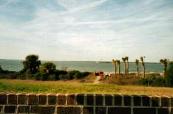
Fort Sumter in distance from Fort Moultrie
Still incomplete in 1860, Fort Sumter was located on a small man-made island in the harbor and could be much more easily defended since any attacking force would have to approach by boat under the guns of the fort. Although the conditions there were much less comfortable than at Fort Moultrie, Anderson made the decision to move his men over.

Led by Anderson in person, the bulk of his force went over to Fort Sumter in boats on the night of December 26, 1860. Left behind were twelve men and a surgeon, commanded by Captain J.G. Foster of the engineers, who were ordered to spike the heavy guns in Fort Moultrie and destroy their carriages. This work was accomplished during the night of the 26th and the fort's flagstaff was also cut down.

To learn more about Fort Moultrie, now a national park area and open to the public daily, please visit www.exploresouthernhistory.com/SCMoultrie1.

Saturday, May 23, 2009

Memorial Day, Part Four - Fort Sumter, South Carolina


Continuing our special Memorial Day series, there are few places in American that hold a history as signficiant as Fort Sumter.

The focal point of a national monument, the battered fortress is located on a small island in Charleston Harbor. Tour boats travel out to the fort from both the Charleston waterfront and nearby Patriot Point Military Museum daily.

During the winter of 1860-1861, the eyes of America and the world were focused on Fort Sumter. South Carolina declared her independence from the Union in December of 1860 and Major Robert Anderson quickly moved his small garrison of U.S. troops from their more exposed position at nearby Fort Moultrie to the isolated fortress in the harbor. State officials demanded that Anderson surrender the fort, but he declined and put his men to work making rapid improvements to Fort Sumter.

Tension grew over the coming months. Other Southern states seceeded and joined with South Carolina in forming the Confederate States of America. General P.G.T. Beauregard was sent to command Southern forces gathering around Charleston Harbor.

The final demand for the surrender of Fort Sumter came on April 11, 1861. Anderson once again refused. The next morning at 4:30 a.m., a mortar shell soared high into the air and exploded over the fort. One by one other Confederate guns joined the action. The first battle of the Civil War had begun.

Fort Sumter surrendered one day later. Not a single man on either side was lost in the battle. Over the next four years, however, hundreds of thousands of Americans would die in the most costly war in American history.

To learn more about Fort Sumter National Monument, please visit www.exploresouthernhistory.com/fortsumter.