Showing posts with label ozarks. Show all posts

Wednesday, July 18, 2012

The Ozark Howler: Monster Cat in the Ozarks?

Ozarks of Arkansas
One of my favorite stories from my years of living in different parts of the South is the tale of the Ozark Howler in Arkansas. (It is also said to live in Missouri and Oklahoma, maybe even in Texas).
Now let me be clear from the start that this mysterious animal or beast or monster or whatever it is has been the focus of an incredibly large number of hoaxes and false reports. One hoaxer even admitted to a researcher that he spread as many false stories as he could to poke fun at the Chupacabra craze that swept through Texas a decade or so ago.

Small Waterfall in the Ozarks
That said, there are real stories from sincere eyewitnesses of a strange creature roaming through the Ozark Mountains. Its nightly cries are said to sound like a the screams of a woman.

I first heard reasonable eyewitnesses talk about the Arkansas Howler in 2004 when I was living in Fort Smith, Arkansas. Several people that I talked to who had seen or heard it or found its prints did not believe it to be a real "monster," but instead thought that a mountain lion or cougar was loose in the Boston Mountains that stretch between Fort Smith and Van Buren on the south and the booming Northwest Arkansas corridor.

Wildlife authorities maintained at that time that there were no native cougars left in Arkansas. Nevertheless, residents who lived in and along the fringes of the Boston Mountains, which are part of the Ozarks, were serious in their claims that a large animal was roaming their neighborhoods.


Cougar as seen in a USDA Photo
The most convincing evidence I saw during my time in Arkansas were photos from a trail cam belonging to a couple that lived north of Van Buren in Crawford County. The photos without doubt showed a large, tawny cat that looked just like a cougar to me. State wildlife officials did not dispute that it could be a big cat, they simply point out that there is no evidence of a breeding population of such animals in Arkansas.

Be that as it may, they do agree that there could be cougars or other large cats roaming the wild areas of the Ozarks, just believe that if they are there, they were someone's pets that either escaped or were released by their owners when they got too big and dangerous.

The Ozarks from White Rock Mountain
Now to be fair, other eyewitnesses claim to have seem something much more monstrous than a cougar in the hills and hollows of the Ozarks. Sightings ranging from a cat much bigger than a cougar to a cat-like monster with glowing eyes and horns growing from its head have been reported.

Whatever it is, and a recent investigation in Newton County, Arkansas, obtained plaster casts of what a biologist identified as possible Puma tracks (Puma is another name for a big cat like a cougar), the Ozark Howler is very much part of the modern folklore and tradition of the Ozarks.

To learn more, please visit www.exploresouthernhistory.com/ozarkhowler.

Monday, February 13, 2012

Eureka Springs - The per capita Wedding Capital of America

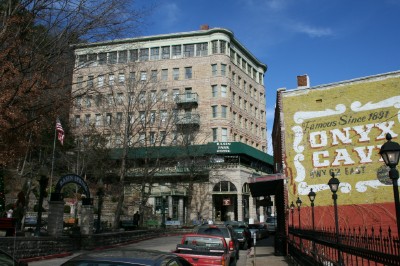
Eureka Springs, Arkansas
It often comes as a surprise visitors that the quaint Victorian town of Eureka Springs, Arkansas, hosts more weddings per capita than any city in the United States.

In fact, some years more people get married in Eureka Springs than actually live there! So I thought in honor of Valentine's Day it would be enjoyable to take a look at this charming community in the Ozark Mountains of Arkansas.

Eureka Springs has always been a special place. The first visitors came back in the late 19th century when dozens of mineral springs were found flowing from the sides of the mountains there. The town was founded in 1877 and in less than one year more than 3,000 people came to live in Eureka.

Historic Downtown of Eureka Springs
They came because of the popularity of mineral springs in those days. People believed the pure water provided cures for a variety of illnesses and the arrival of the railroad brought crowds in to enjoy the spas, hotels and other amenities of the resort community in the Ozarks.

The belief in the power of water from mineral springs diminished in the 20th century, but unlike many such places, Eureka Springs preserved its beautiful atmosphere and architecture. It stands today as one of the most beautifully preserved Victorian towns in the world. The romance of days gone by is unmistakable and the town offers beautiful historic accommodations, restaurants, shops and entertainment. Carriages roll through the streets and couples walk hand in hand along the sidewalks.

Crescent Hotel in Eureka Springs
And there are weddings. More weddings than can be imagined. There is no blood test and no waiting to get married in Eureka Springs. A couple can arrive, get their license, get married and be on their honeymoon in a beautiful historic hotel, bed and breakfast or more modern accommodation in less than 90 minutes.

An array of wedding locations are available, ranging from the simple to the elegant, or one of the town's many ministers will come to you and perform a wedding at the location of your choice. An overlook on East Mountain, for example, provides a spectacular view of the valley and Victorian town and is popular for couples looking to marry surrounded by the beauty of the mountains.

To learn more about Eureka Springs, please visit www.exploresouthernhistory.com/eurekaindex.

For complete information on getting married in Eureka Springs, please visit www.exploresouthernhistory.com/eurekaweddings.

Saturday, October 1, 2011

Best Autumn Drives #3 - Pig Trail Scenic Byway, Arkansas

Ozark Mountains of Arkansas
Continuing our look (not in any particular order) of some of the best autumn drives in the South, this post focuses on the famed Pig Trail Scenic Byway in Arkansas.
So named because it is used as a short cut by many fans on their way to University of Arkansas Razorbacks football games on weekends in the fall, the Pig Trail passes through some of the prettiest scenery in the Ozarks.

The Pig Trail actually originated as a winding trail that provided foot access for ancient Indian hunters as they made their way into the mountains of the Ozarks from the Arkansas River Valley. When French hunters and trappers arrived in Arkansas during the 1600s, they discovered this path and used it as well. In fact, they gave the name Aux Arcs (which has been corrupted in English to "Ozarks") to the wide bend of the river at the point it is intersected by the trail. This is now the site of the town of Ozark.

Pig Trail Scenic Byway
In later years, the trail was used by early settlers of the mountains and later by Union and Confederate soldiers, as well as the riders of the vicious guerrilla bands that infested the region, during the Civil War.

The mountains surrounding the Pig Trail became part of the Ozark National Forest when it was established in the early 1900s and over the years the road became a favorite way to access the mountains and the beautiful Mulberry River area. The National Forest Service designated it as a scenic byway and today it provides a way for visitors to explore a stunning area of mountains, valleys, wild rivers and waterfalls.

To learn more about the Pig Trail Scenic Byway, please follow this link: http://www.exploresouthernhistory.com/pigtrail.html.

Wednesday, September 16, 2009

Pedestal Rocks Scenic Area - Ozark National Forest, Arkansas

Located deep in the mountain country of the Ozarks and just off famed Scenic Highway 7, some of the most beautiful and historic scenery in the South can be found at Pedestal Rocks Scenic Area.

Named for the magnificent pedestals of stone formed by natural erosion of a towering bluff, the park features hiking trails that least to the pedestals, natural arches, erosion caves and one of the tallest waterfalls in Arkansas. The bluff top provides spectacular views of the valley and mountains beyond and is stunning in October when fall colors reach south into the Ozarks.

Archaeologists have learned that Native Americans used the natural caves and rock shelters at Pedestal Rocks thousands of years ago. They used this natural shelter while hunting and gathering in the mountains. In later times, the territory surrounding the scenic area was the domain of the Civil War guerrilla bands that roamed the Ozarks.

The scenic area is now part of the Ozark National Forest and is open daily. To learn more, please visit www.exploresouthernhistory.com/pedestalrocks.

Wednesday, June 24, 2009

Summer Escapes #1 - White Rock Mountain, Arkansas


With much of the Deep South gripped in a heat wave, I thought I would spend some time over the next week or so telling you more about some of my favorite summer escapes.

White Rock Mountain is located in the Ozarks of western Arkansas. An easy drive (if you don't mind a few bumps and dirt roads!) from Fort Smith and Fayetteville as well as the growing Northwest Arkansas Metro, the mountain is part of the Ozark National Forest and offers some of the most spectacular views in the region.

Historically, the mountain is unique because it overlooks some of the rugged land popular as hideouts for guerrilla bands during the Civil War and the rough years that followed. The park on the top, along with its beautiful old stone cabins and lodge, was a Depression-era project that is now more than 70 years old. The cabins and lodge have been restored and the park is among the most beautiful in the South.

What makes White Rock Mountain such a great hot weather escape, particularly for those suffering in the heat and humidity of the Arkansas River Valley, is the fact that the overlook on the point of the mountain projects out over two connecting valleys. The breezes swirling up to the point are cool and refreshing on almost any summer day. The temperature on top of the mountain is well below that down in the valleys.

To learn more, please visit www.exploresouthernhistory.com/whiterock.


Friday, February 13, 2009

White Rock Mountain - Arkansas


Located deep in the Ozark National Forest in western Arkansas, White Rock Mountain provides some of the most spectacular views to be found in the South.

A part of the Ozarks region that covers large areas of Arkansas, Missouri, Oklahoma and Kansas, the mountain takes its name from the sheer rock cliffs that surround its crest. An unusual lichen that grows on the rocks give the cliffs a striking white appearance when viewed from a distance.

The drive to the mountain is a bit of an adventure. It requires navigating several miles of bumpy and often steep gravel roads, but the view at the top is well worth the journey. A recreation area that is now itself a historic site was built atop the mountain as a public works project during the Great Depression. Three original stone cabins and a beautiful old lodge are now available there for overnight guests. In addition, hiking trails lead past a series of overlooks built by Depression era workers to help visitors experience the spectacular mountain views.

To learn more, please visit www.exploresouthernhistory.com/whiterock. One note, this area of the Ozarks experienced heavy damage in this year's ice storm. The cabins, etc., on the mountain are open, but cleanup work is continuing on roads, hiking trails and at other recreation spots in the area.

Monday, February 9, 2009

Pig Trail Scenic Byway - Arkansas


This charming little waterfall is Pig Trail Falls, located along the Pig Trail Scenic Byway in the Arkansas Ozarks.

The Pig Trail takes its name from its popularity as a short cut across the mountains for Arkansas Razorbacks fans on their way to and from games at the University of Arkansas in Fayetteville.

Stretching for 19 miles through the Ozark National Forest, the Pig Trail follows an old road that was in use in the earliest days of Arkansas. Well developed by the time of the Civil War, the road was used by both Union and Confederate forces. General W.L. Cabell led 900 men north along the road in the spring of 1863 on an expedition that ended at the Battle of Fayetteville.

Then as now, the road that became the Pig Trail led past beautiful waterfalls, Ozark mountain country and over the scenic Mulberry River (popular for canoing and kayaking).

To learn more, please visit www.exploresouthernhistory.com/pigtrail.

Sunday, July 6, 2008

Historic Sites of Branson, Missouri - Part Five


This is a view of the bison or buffalo herd at Dogwood Valley Nature Park near Branson, Missouri.
It is difficult to believe today, but these huge and majestic animals once roamed the Ozarks in great herds. Over hunting and the expansion of the frontier drove them out of the region in just a few decades.
Today, however, they can be seen again grazing in sight of the mountains. Dogwood Valley, owned jointly with nearby Big Cedar Lodge by Bass Pro Shops, preserves thousands of acres of beautiful Ozark scenery. The naturalists there are working to reintroduce a variety of rare native animals to the park, including bison and elk. They can be seen on the guided tram tour that takes visitors through miles of beautiful park terrain.
Our series will continue. To read more before the next post, please visit www.exploresouthernhistory.com/branson1.

Monday, June 30, 2008

Historic Sites of Branson, Missouri - Part One


We turn our focus today on the major Southern resort city of Branson, Missouri.
Known around the world for its music and live entertainment, there is also a great deal in Branson for the history minded visitor.
The city is located in the beautiful and mysterious Ozarks region of southern Missouri. These mountains, hills and valleys fostered a lifestyle unique in the South during the decades before the Civil War, during and after the Civil War.
As they drifted west from the east, settlers roamed into the mountains and established small farms, mills and trading stores. They were tough, determined people who scratched a living from the mountain soil and developed a culture unlike any other in America.
Union and Conferate forces moved through this region during the Civil War, as did irregular bands of guerrilla fighters. Jesse James is among the names often mentioned in the area. There were also regular armies, however, and the Battle of Wilson's Creek was fought just 50 miles north of Branson on the outskirts of Springfield.
Over the next few days we will be looking at a wide variety of historic sites in and around the Branson area. I think you will find this to be a fascinating journey into the Missouri Ozarks and hope you will check back often.
Until the next post, you can learn more by visiting www.exploresouthernhistory.com/branson1.

Saturday, June 28, 2008

Coming on Monday - Historic Sites of Branson, Missouri


The fascinating city of Branson, Missouri, is known world-wide for its live shows and entertainment. 60 Minutes called it the "Live Country Music Capital of the Universe" and with good reason.
What many visitors do not realize, however, is that the city is also a centerpiece for the culture and history of the Missouri Ozarks. The entire Branson area is rich in history, culture, folklore and spectacular natural scenery.
Beginning Monday, we will start a series that will give you a tour of the "other Branson." Be sure to check back then to learn more about the fascinating historic sites, culture, natural wonders and heritage of Branson and the Missouri Ozarks.

Tuesday, March 18, 2008

Roaring River State Park - Cassville, Missouri


One of the most beautiful natural and historic settings in the Ozarks can be found at Roaring River State Park near Cassville, Missouri.
This strikingly beautiful state park is only 20 miles from Eureka Springs and about 50 miles from Branson, two of the most popular destinations in the South.
Covering thousands of acres of beautiful mountain and valley scenery, the park is centered around Roaring River Spring. The 20th largest spring in Missouri, Roaring River Spring flows from a fascinating cavern and forms one of the most popular trout fishing streams in the Ozarks.
To learn more about this beautiful Missouri state park, visit our new Roaring River page. You can access it by visiting www.exploresouthernhistory.com. Just follow either the Branson, Missouri or Eureka Springs, Arkansas heading and you will find a link for Roaring River State Park.

Sunday, February 17, 2008

The Battle of Dripping Springs, Arkansas


Over the next few days we are exploring the Battle of Dripping Springs, Arkansas on our sister blog, Arkansas in the Civil War.
This battle was fought on December 28, 1862, between Confederate and Union troops in the edge of the Ozarks north of the city of Van Buren, Arkansas.
It was an important preliminary action to the Battle of Van Buren, fought later that day.
If you would like to read more, visit the blog or go to the Battle of Dripping Springs page at www.exploresouthernhistory.com (just look under the Battlefields and Forts heading in the left hand column).