Showing posts with label mississippi. Show all posts

Saturday, June 28, 2014

4th of July Fireworks are underway!

4th of July Fireworks for 2014 are underway!
4th of July fireworks are underway across the South!

Tonight (Saturday, 6/28/2014) is the first big night of the week-long celebration, with shows scheduled for Alabama, Arkansas, Mississippi, North Carolina, Oklahoma, South Carolina, Tennessee, Texas and Virginia. More shows continue tomorrow with the big weekend set to get underway on Wednesday, July 3rd.

As always, you can check out locations, times and dates for the best fireworks in each state in the South by visiting www.exploresouthernhistory.com/fireworks.


Monday, March 17, 2014

Mississippi's Singing River - The Mysterious Song of the Pascagoula

The Pascagoula - Mississippi's "Singing River"
Roughly 80 miles long and draining an area of 8,800 square miles along the border of Mississippi and Alabama, the Pascagoula River is a major source of clean, fresh water for the Gulf of Mexico. It holds a unique place in Southern culture as the "Singing River" of the Mississippi Gulf Coast.

When French settlers arrived in the region in 1699, they heard a remarkable sound rising from the waters of the Pascagoula. The river takes its name from the Pascagoula Indians, a tribe with with a name that translates literally to "bread eaters."

The people of this tribe told the French that an earlier people had lived on the modern site of Pascagoula. These Native Americans, they said, had worshiped a mermaid who lived in the river. In their temple was a beautifully carved idol of the mermaid, around which the villagers gathered each night to sing and chant.

A strange, repetitive humming sound rises from the river.
At around the time of the Hernando de Soto expedition (1539-1540), however, the Pascagoula said that a strange white man had appeared in the town of the mermaid worshipers. He brought a book and a cross and sought to convert them to Christianity. This angered the mermaid herself, prompting her to rise from the bottom of the river with dramatic fury:

...One night, when the moon at her zenith poured on heaven and earth, with more profusion than usual, a flood of light angelic, at the solemn hour of twelve, when all in nature was in repose and silence, there came, on a sudden, a rushing on the surface of the river, as if the still air had been flapped into a whirlwind by myriads of invisible wings sweeping onward. - Charles Gayerre, History of Louisiana, 1867.

The Pascagoula River.
The water rose up into a "towering column" and at the top stood the mermaid herself. She began to sing a haunting song, calling out to her followers. One after another every man, woman and child in the village walked into the river and were never seen again. According to a 19th century historian, the Pascagoula and other tribes that lived in the area "have always thought it was their musical brethren" who made the sounds of the singing river. Their ghosts, they said, lived on in the palace of the mermaid far beneath the waves.

It is a tragic and unusual story but appears to be the oldest version of a legend still repeated in Mississippi about the American Indians who once lived along the banks of the Pascagoula. Other versions hold that the villagers walked into the river to avoid losing their freedom at the hands of a neighboring tribe or the Spanish conquistadors.

The story was the Pascagoula's way of explaining the strange music that came from the river that bore their name.

Does the river really sing?  Find out by visiting our new page: The Pascagoula - Mississippi's Singing River.

Wednesday, October 30, 2013

Some new Ghost Stories for Halloween 2013!

The Ghost of Bellamy Bridge
Marianna, Florida
One of the most popular pages at ExploreSouthernHistory.com is our collection of stories about the Ghosts & Monsters of the South.

For Halloween 2013, we have added some new stories that you might enjoy.  From a headless horse in Southwest Georgia to a ghost ship crewed by pirates in the Everglades, I think you will enjoy these journeys into the folklore of the South!

New stories for 2013:


Other favorites:
Don't forget you can access all of these stories and many others anytime at www.exploresouthernhistory.com/ghosts.

Thursday, July 4, 2013

The Fall of Vicksburg, 150 years ago today (July 4, 1863)

Vicksburg, Mississippi
150 years ago today, the Confederacy's "Gibraltar of the Mississippi" fell to the army of Maj. Gen. Ulysses S. Grant. It was a devastating blow from which the South would not recover.

The final acts in the moments leading to the surrender of Vicksburg were enacted before dawn on the morning of July 4, 1863. Having considered a final proposal from Lt. Gen. John C. Pemberton (CS), Gen. Grant (US) sent a letter through the lines to his Confederate counterpart:

Union battery before Vicksburg
     ...I can make no stipulations with regard to the treatment of citizens and their private property. While I do not propose to cause them any undue annoyance or loss, I cannot consent to leave myself under any restraint by stipulations. The property which officers will be allowed to take with them will be as stated in my proposition of last evening; that is, officers will be allowed their private baggage and side-arms, and mounted officers one horse each.
     If you mean by your proposition for each brigade to march to the front of the lines now occupied by it, and stack arms at 10 a.m., and then return tot he inside, and there remain as prisoners until properly paroled, I will make no objection to it. - Maj. Gen. Ulysses S. Grant, USA (July 4, 1863).

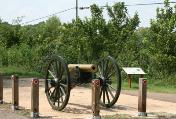
Confederate cannon at Vicksburg
In closing his final offer, Grant informed Pemberton that if he received no reply by 9 a.m., hostilities would resume. To avoid this, the Confederates should display white lines along their lines.

Pemberton reviewed the note and early on the morning of July 4, 1863, agreed to surrender Vicksburg, Mississippi, to the United States:

GENERAL:  I have the honor to acknowledge the receipt of your communication of this day, and in reply to say that the terms proposed by you are accepted. - Lt. Gen. John C. Pemberton, CSA (July 4, 1863).

Later in the morning, as the Union forces crowded to the tops of their breastworks and fortifications to watch, the Confederate army came out of its trenches for the first time in more than 45 days:

Former channel of the Mississippi at Vicksburg
...[T]he garrison was surrendered at 10 a.m., and the Federal forces immediately took possession of our works and placed guards in the city. If it should be asked why July 4 was selected as the day for the surrender, the answer is obvious. I believed that upon that day I should obtain better terms. Well aware of the vanity of our foes, I knew they would attach vast importance to the entrance on July 4 into the stronghold of the great river, and that to gratify their national vanity they would yield then what could not be extorted from them at any other time. - Maj. Gen. John C. Pemberton, CSA (August 2, 1863).


Union cannon at Vucksburg
Pemberton was right in his assessment of how the Union would regard the surrender of Vicksburg on the 4th of July. It was hailed across the North with celebrations and bonfires. Gen. William Tecumseh Sherman, Grant's friend and trusted subordinate, predicted the reaction of the Northern states and gently warned his commander about the fleeting nature of fame. He also commended him for his generosity to the Confederates who had fought from the trenches of Vicksburg for 47 days:

...I can hardly contain myself. Surely will I not punish any soldier for being "uncohappy" this most glorious anniversary of the birth of a nation, whose sire and father was a Washington. Did I not know the honesty, modesty, and purity of your nature, I would be tempted to follow the examples of my standard enemies of the press in indulging in wanton flattery; but as a man and soldier, and ardent friend of yours, I warn you against the incense of flattery that will fill our land from one extreme to the other. Be natural and yourself, and this glittering flattery will be as the passing breeze of the sea on a warm summer day. To me the delicacy with which you have treated a brave but deluded enemy is more eloquent than the most gorgeous oratory of an Everett. - Gen. William Tecumseh Sherman, USA (July 4, 1863).


Old Courthouse in Vicksburg
While the main army remained outside the city, a small force of Union troops entered Vicksburg on July 4, 1863 - 150 years ago today - and raised the U.S. flag from the top of the Warren County Courthouse. The historic building still stands in Vicksburg today, where it is now a museum and is generally known as the "Old Courthouse."

With the fall of Vicksburg, only one Confederate bastion - Port Hudson, Louisiana - remained along the full length of the Mississippi River. I will focus on events at that battlefield over coming days.

To learn more about the Battle of Vicksburg and the historic city itself, please visit www.exploresouthernhistory.com/vicksburg1.

Wednesday, July 3, 2013

Fireworks across the South Tonight (7/3/2013)

4th of July Fireworks explode over the South
Courtesy Pine Bluff Festival
Fireworks are set to launch at locations all across the South tonight!  Weather conditions could cause issues in some areas, so be sure to check local conditions before heading out!

Here are some highlights of what is happening and where its happening tonight!


Alabama

Major fireworks displays are set for tonight - weather permitting - in Chelsea, Fort Rucker, Jacksonville and Montgomery! A major highlight is the Fort Rucker Freedom Fest. The post plans to go forward with its fireworks, even though many military bases in the South have cancelled their annual shows.

Please click here to see the full list of fireworks in Alabama for July 3rd and 4th with times and locations.


Arkansas

The skies of the Natural State will light up tonight with fireworks in Bella Vista, Calico Rock, De Queen, Hot Springs, Paris and Rogers. The Hot Springs event features a concert by Lee Greenwood of "I'm proud to be an American" fame.

Please click here for the full list of fireworks in Arkansas for July 3rd and 4th.


Florida

Florida's 4th of July fireworks for this year begin with the Old Apalachicola Independence Day in Apalachicola and fireworks in Aventura.  The Apalachicola event - weather permitting - will feature a parade, ice cream social, live music and more.

Please click here for Florida's fireworks for this July 3rd and 4th.


Georgia

Georgia's 4th of July celebrations launch into high gear tonight with events in Atlanta, Cumming, Dawsonville, Forsyth, McCaysville/Copperhill, Kennesaw, Tifton, Villa Rica and Woodbury. The Tifton event includes a variety of activites at the Georgia Museum of Agriculture and Historic Village!

Please click here for a full list of Georgia fireworks for July 3rd and 4th.


Kentucky

Fireworks launch tonight from locations all over Kentucky.  Events are set for Bowling Green, Dawson Springs, Gilbertsville, Louisville, Madisonville, Somerset and Winchester. Among the highlights are the first night of Louisville's two night Waterfront Independence Festival, the Kentucky Lake Big Bang in Gilbertsville and the Thunderfest Independence Day Celebration at the National Corvette Museum in Bowling Green.

Please click here for a full list of Georgia fireworks for July 3rd and July 4th!


Louisiana

Four major fireworks shows are set for Louisiana tonight. Events are set in Jennings, Metarie, Ponchatoula and Youngsville. Highlights include the Uncle Sam Jam at Lafreniere Park in Metarie and Youngsville's Independence Day Celebration which will include both fireworks and hot air balloon rides!

See the full list of Louisiana fireworks for July 3rd and 4th by clicking here!


Mississippi

Fireworks take place in Pearl, Mississippi, tonight after the 7 p.m. baseball game between the Mississippi Braves and the Mobile Bay Bears.

Click here for the full list of Mississippi fireworks set for July 3rd and July 4th.


North Carolina

The Independence Day celebration gets underway in North Carolina with nearly one dozen events tonight (July 3rd).  Fireworks displays are set for Asheville, Carolina Beach, Charlotte, Cherryville, Harrisburg, Mooresville, Statesville and Wake Forest (the city, not the school).

Click here for 2013's list of North Carolina Fireworks set for July 3rd and 4th.


Oklahoma

Big fireworks events are set for Oklahoma tonight, including Red White & Boom in Oklahoma City.  Events are also set for Claremore, Talihina and Yukon, with more to come tomorrow!

Check out this year's list of Oklahoma Fireworks for July 3rd and 4th.


South Carolina

Fireworks will launch in Cheraw and Columbia tonight, with South Carolina's main list of 4th of July celebrations planned for tomorrow.

Click here for South Carolina's fireworks for July 3rd and July 4th.


Tennessee

There is a long list of fireworks set for Tennessee tonight, with more to follow tomorrow night!  Fireworks will launch tonight in Bartlett, Chattanooga, Clarksville, Collierville, Collegedale, Copperhill/McCaysville, Dandridge, Hendersonville, Millington and Waynesboro.

Please click here to see Tennessee's fireworks list for July 3rd and July 4th.


Texas

The Lone Star State kicks its 4th of July celebration into high gear tonight with music, events, airshows, fireworks and more!  The Atlanta Rhythm Section will perform live in Arlington, followed by fireworks, with events also taking place in Addison, Coppell, Farmers Branch, Fort Worth, Gilmer, Irving, Sachse and Sherman.

Click here to see the full list of Texas fireworks for July 3rd and July 4th.


Virginia

Fireworks start launching in Virginia shortly after dark tonight, with events scheduled for Chesapeake, Doswell, McGaheysville, Richmond, Ridgeway and South Hill.  More will follow tomorrow!

Click here to read the full list of Virginia fireworks for July 3 & 4, 2013!


Don't forget you can check the full list of fireworks from all Southern states online at www.exploresouthernhistory.com/fireworks.


Monday, July 1, 2013

Vicksburg and Port Hudson - The "other" battles of July 1863

Confederate Cannon and the Mississippi River at Vicksburg
The nation is remembering the Battle of Gettysburg this week, and appropriately so, but seems a bit sad to me that we seem to have forgotten that another major and bloody battles took place at the same time on the bluffs of Vicksburg, Mississippi, and Port Hudson, Louisiana.

These battles were as significant victories for the North as Gettysburg and even a greater disasters for the South. The fall of the Vicksburg on July 4, 1863 - 150 years ago this week - and Port Hudson on July 9, 1863, cut the Confederacy in two and opened the Mississippi River to the supply and warships of the Union.

Port Hudson Battlefield in Louisiana
The opening of the Mississippi was a vital part of the "Anaconda Plan" conceived by Gen. Winfield T. Scott, the aged hero of the War of 1812 and War with Mexico who commanded the U.S. Army at the beginning of the War Between the States. Combined with the blockade of the Southern coastline, the opening of the Mississippi would strangle the Confederacy by cutting off the movement of supplies, munitions, medicines and other necessities of its armies.

By July of 1863, only two great Confederate bastions remained on the river, Vicksburg in Mississippi and Port Hudson in Louisiana. In both places, Confederate armies dug deep into the earth and clung to earthwork fortifications in desperate fights for survival. They had fought desperately and hurled back attack after attack, covering the ground with the blood and blue uniformed bodies of Union soldiers.

Some of the Thousands who Died
At Port Hudson, just a 30 minute drive north of Baton Rouge today, 10,000 Union soldiers were reported killed, wounded or missing, compared to a Confederate loss of 750 in actual combat.

At Vicksburg, Union commanders estimated that they lost 4,835 men killed, wounded or missing. The Confederates estimated that their actual combat losses were 3,202 men killed and wounded.

So much blood was spilled on the bluffs at Port Hudson and Vicksburg that it is difficult to imagine the true cost in human suffering of the two battles. Combined, the two battles left nearly 19,000 men dead, wounded or missing.

I will tell you more about them over coming days, but it seemed appropriate, as the massive commemoration of Gettysburg begins, that we also remember the men of Vicksburg and Port Hudson.

You can read more about the battlefields by visiting:


Saturday, June 29, 2013

4th of July Fireworks continue Tonight!

Fireworks over Arkansas
Courtesy Pine Bluff Festival Association
4th of July Fireworks continue around the South tonight, with a wide range of events scheduled for the next seven days.

My annual list of 4th of July Fireworks in the South is now online at www.exploresouthernhistory.com/fireworks, so check it out for a state by state guide to the best displays!

Here are some highlights for you from this weekend's planned events:


Alabama (June 29 & 30, 2013)

Boaz, Cedar Bluff, Columbiana, Thomasville and Tuscumbia will all host events on Saturday and Wilsonville's annual God & Country Celebration is set for Sunday.

To learn more about these and other 4th of July Fireworks Events in Alabama for 2013, please visit www.exploresouthernhistory.com/alabamafireworks.


Arkansas (June 29 & 30, 2013)

Texarkana's big Sparks in the Park will take place on Saturday night at Bobby Ferguson Park. Gates open at 4 p.m.for food, activities, contests and more. The fireworks will launch at 9:30 p.m.

Springdale will launch its Fireworks at the Cross at the CrossChurch Pinnacle Hills Campus on Sunday night.  Events begin at 5 p.m. with live music, outdoor baptisms and more. The fireworks go up at dark.

To learn more about this year's 4th of July Fireworks in Arkansas, please visit www.exploresouthernhistory.com/arkansasfireworks.


Florida

Florida's events don't get started until July 3rd, but you can check out the schedule of planned fireworks for the Sunshine State at www.exploresouthernhistory.com/floridafireworks.


Georgia  (July 1, 2013)

Georgia's fireworks for this year get underway on Monday, July 1st, as Auburn (GA) hosts its annual fireworks in the downtown area. The skies light up at dark.

To learn more about the full list of this year's 4th of July fireworks in Georgia, please visit www.exploresouthernhistory.com/georgiafireworks.


Kentucky (June 29, 2013)

Kentucky begins to light up its skies on Saturday night with the Briggs & Stratton Fireworks Extravaganza in Murray. Fireworks launch at 9:30 p.m. on the 29th in the area around Kroger, Wal-Mart and Lowes.

The full list of fireworks in Kentucky is available at www.exploresouthernhistory.com/kentuckyfireworks.


Louisiana (June 29, 2013)

Lake Arthur leads the way this year in Louisiana with its Lake Arthur Freedom Fest on Saturday (June 29th). The gates of Lake Arthur Park open at 8 a.m. for a day of fun.  The Blessing of the Fleet is set for 3 p.m., followed by music from Jamie Bergeron & the Kickin' Cajuns, Travis Matte & the Kingpins and the Bon Journeys.  The fireworks launch at 8:30 p.m.  Admission is $5 with kids 5 and under admitted free.

See the full list of this year's Louisiana fireworks at www.exploresouthernhistory.com/louisianafireworks.


Mississippi (June 30, 2013)

Mississippi's 4th of July Fireworks for 2013 get started on Sunday night in Hattiesburg and Brandon (Ross Barnett Reservoir).

Temple Baptist Church in Hattiesburg hosts Celebrate America on Sunday night (June 30th). The event begins with a community-wide picnic and fun at 6:30 p.m., followed by the fireworks at 9:00 p.m.

The Annual Independence Day Celebration at Ross Barnett Reservoir also takes place on Sunday. Events begin at 5 p.m. at Lakeshore Park and Old Trace Park in Brandon.  There will be live music at 6 p.m., a boat parade at 8 p.m. and fireworks at 9 .m.

Check out Mississippis's complete list of 4th of July Fireworks at www.exploresouthernhistory.com/mississippifireworks.


North Carolina 

Events don't get started in North Carolina until July 3rd, but you can check out the full list of events in the Tarheel State here:  www.exploresouthernhistory.com/ncfireworks.


Oklahoma (June 29, 2013)

The skies over Oklahoma City come alive on Saturday night (June 29th) with the annual Stars & Stripes River Festival. Taking place in the Boathouse District, the event features river sports, games, activities and more throughout the day followed by fireworks at dark.

Check out the complete list of Oklahoma's fireworks for this year at www.exploresouthernhistory.com/okfireworks.


South Carolina (June 29, 2013)

The big 4th of July Celebration and Boat Parade takes place at South Carolina's Lake Murray on Saturday (June 29th). A popular event in the Midlands, the boat parade takes place at 12 noon followed by the fireworks at dark.

See South Carolina's complete list of 4th of July Fireworks at www.exploresouthernhistory.com/scfireworks


Tennessee (June 29, 2013)

Tennessee's 4th of July Fireworks will begin with three events on Saturday night (June 29th).

Alcoa hosts its FreedomFest on Saturday with fireworks at dark. Andersonville's Sequoyah Marina on Norris Lake is home to Fire on the Water which features food, fun and fireworks. Byrdstown's Independence Day Celebration takes place in the parking lot across from Town Hall on Saturday night and begins with a benefit for Our Troops at 5 p.m., followed by music and games.  The fireworks begin at 9 p.m.

Check out the full list of 4th of July Fireworks in Tennessee this year at www.exploresouthernhistory.com/tnfireworks.


Texas (June 29 & 30, 2013)

Texas begins its 4th of July Fireworks on Saturday and Sunday nights, June 29th and 30th.

Allen's annual Market Street Allen USA Celebration is set for Saturday at Celebration Park. Former Styx  lead singer Dennis DeYoung is among the performers set to entertain the crowds. Music, fun, activities, food and more begins at 4 p.m., followed by the fireworks at dark.

Parker's Celebrate Freedom event takes place at Southfork Ranch on Saturday. The gates open at 8 a.m. for activities, food, fun and more. Live music begins at 10 a.m. and the fireworks will launch at Dark.

Rockwall's Freedom Fest 2013 will take place on Sunday at The Harbor. Food, fun, entertainment and activities kick off at 4 p.m. and will be followed by the fireworks at dark.

Check out the full list of Texas 4th of July Fireworks for this year at www.exploresouthernhistory.com/texasfireworks.


Virginia 

Things don't get going in Virginia until July 3rd, but you can check out the full list of Virginia 4th of July Fireworks for 2013 at www.exploresouthernhistory.com/virginiafireworks.


Remember, you can access the full list for all states anytime at www.exploresouthernhistory.com/fireworks.


Wednesday, May 22, 2013

Grants Grand Assault on Vicksburg (May 22, 1863)

Railroad Redoubt at Vicksburg, Mississippi
Blue (U.S.) and Red Signs (C.S.) show the scene of hand to hand fighting.
150 years ago today, after one of the most ferocious bombardments ever unleashed on an American city, Gen. Ulysses S. Grant sent his Union army forward against the Confederate defenses of Vicksburg, Mississippi.  It was an unmitigated disaster.

Grant had closed in on Vicksburg from the east 4 days earlier after battling Confederate forces at Port Gibson, Raymond, Big Black River and other locations. The Confederate commander, Gen. John Pemberton, fell back into the prepared fortifications that ringed Vicksburg and prepared to defend the vital city that controlled traffic on the Mississippi River and provided a link between the two halves of the Confederacy that the river divided.

Stockade Redan at Vicksburg
In a first attempt to break through Pemberton's lines, the Union commander had sent Gen. William Tecumseh Sherman forward against the Stockade Redan on May 19, 1863. Confederate forces - primarily the 36th Mississippi Infantry - sent Sherman's men reeling back for their own lines. Confederate losses in the assault, the first fighting of the Battle of Vicksburg, totaled 8 killed and 62 wounded. Union casualties were much higher, with 157 killed and 777 wounded.

Grant tried again three days later on May 22, 1863. It was that attack, which took place 150 years ago today, that resulted in some of the bloodiest fighting of the Siege and Battle of Vicksburg.

Confederate Cannon at Vicksburg

Pemberton's men knew the attack was coming when, on the previous night, the Union army opened on the city with more than 220 cannon. The warships of the Union navy steamed to within range and joined in the bombardment, as soldiers and civilians alike in the beleaguered city dug tunnels to protect themselves from the falling shells.

Then, at 10 o'clock a.m., the Union army advanced. Watching from their lines, the Confederates saw enemy columns forming for attacks on the Stockade Redan, Great Redoubt, Third Louisiana Redan, Second Texas Lunette and the Railroad Redoubt. In the military terms of the day, a redan was a triangular fortification, a lunette was a semi-circular or crescent fortification and a redoubt was a square or rectangular fort.


Second Texas Lunette
Confederate cannon swept the field as the three-mile wide attack developed. The attacks on the Stockade Redan and Great Redoubt were driven back with heavy losses. The Federals almost broke through at the Second Texas Lunette, where heavy fighting took place before Confederate troops finally broke apart their attack.

The critical moment of the day came, however, when Union soldiers stormed over the walls of the Railroad Redoubt and drove out its Confederate defenders. The desperately needed break in the Southern lines had been achieved, but before the Federals could exploit the advantage gained at the redoubt, Waul's Texas Legion counterattacked and drove them out in hand-to-hand fighting.

When all was said and done, the Confederacy still held Vicksburg and Grant had lost more than 3,000 men compared to a loss of around 500 for Pemberton.

To learn more about the Battle of Vicksburg and to check the schedule of planned 150th Anniversary events planned for this Memorial Day Weekend, please visit www.exploresouthernhistory.com/vicksburg1.

Sunday, May 19, 2013

Sherman's Attack on Vicksburg (May 19, 1863)

Stockade Redan and Scene of Sherman's Attack
As the sun set over the high bluffs of Vicksburg, Mississippi, 150 years ago tonight, darkness fell to the sounds of groans and cries for help coming from hundreds of Union soldiers.

It was 150 years ago today, on May 19, 1863, that Union Gen. Ulysses S. Grant ordered Gen. William Tecumseh Sherman to hurl his forces against the Stockade Redan, one of the powerful Confederate forts that ringed the city of Vicksburg. Grant hoped to strike a severe blow against the Southern defenses and break through into the city.

Stockade Redan from the Confederate Lines
The redan (a triangular fort) was powerfully-built, with earthen walls that were 17 feet high and a ditch of dry moat more than 8 feet wide. In front of the Stockade Redan was a cleared field of fire across which the Federals would have to advance into a hail of musket and cannon fire not only from the redan, but from an entire section of the Confederate line.

Stockade Redan was defended by the soldiers of the 36th Mississippi Infantry.

The Union soldiers attacked valiantly, but the Confederates were ready for them. By the time the heavy firing ended, Sherman's men had been hurled back in a bloody defeat. The Federals lost 157 killed and 777 wounded, while the Confederate army of Gen. John C. Pemberton lost only 8 killed and 62 wounded.

Rebel yells flowed over the open ground where masses of men in blue writhed in pain and agony. It would take all night to clear the wounded and give them even a semblance of care.

With the failed Union attack, the Battle of Vicksburg had begun. It would continue for more than six more weeks and when all was said and done, the Vicksburg Campaign would cost 20,000 men their lives. The fall of the city would break the Confederacy in two and give the Union control of the Mississippi River.

To learn more about the battle, please visit www.exploresouthernhistory.com/vicksburg1.

To learn more about events planned for the 150th anniversary of the battle, please visit http://southernhistory.blogspot.com/2013/05/vicksburg-150th-anniversary-events-set.html.


Tuesday, July 17, 2012

Tennessee Williams Boyhood Home - Columbus, Mississippi

Tennessee Williams Birthplace & Boyhood Home
Columbus, Mississippi
The famed American writer Tennessee Williams was born in this Victorian home in Columbus, Mississippi. The house today serves as the city's official welcome center.

Tennessee Williams was born as Thomas Lanier Williams on October 26, 1911. His grandfather, Rev. Walter Dakin, was rector of St. Paul's Episcopal Church in Columbus and his daughter and son-in-law were then living in the rectory as well. Thought to have been built in around 1875, the charming and colorful Victorian home served as home for the future playwright and writer for three years.

The Pulitzer Prize winning writer lived here for 3 years.
Adopting the name Tennessee, Williams of course went on to write two Pulitzer Prize winning plays, "Cat on a Hot Tin Roof" and "A Streetcar Named Desire." He noted in a letter to his grandfather once that much of his writing was based on Columbus, Mississippi. Scholars also agree that he relied heavily on his own family for the characters in his plays and books.

Columbus is unique in that it has had close associations with two Pulitzer Prize winners. Novelist Eudora Welty attended what is now Mississippi University for Women (lovingly called the "W") in Columbus. She received a Pulitzer in 1973 for The Optimist's Wife.

When the Tennessee Williams Birthplace was threatened with demolition in 1993, the community came together and the home was relocated to 300 Main Street in the city and beautifully restored to its 1911 appearance. It is now open to the public and has been designated a Literary Landmark by the Friends of Libraries, U.S.A.

To learn more, please visit www.exploresouthernhistory.com/tennesseewilliams.

Sunday, July 15, 2012

Stephen D. Lee Home & Museum - Columbus, Mississippi

Stephen D. Lee Home in Columbus, Mississippi
Stephen D. Lee was a remarkable soldier, political leader, preservationist and educator. At the age of thirty, he became the Confederacy's youngest lieutenant general. Wounded twice in combat, he fought on fields ranging from Second Manassas and Antietam to Tupelo and Nashville.
His home is a treasured museum today in Columbus, Mississippi. Inherited by his wife, the beautiful old brick residence was General Lee's home after the War Between the States (or Civil War) when he did some of his most noteworthy public service.


Lt. Gen. Stephen D. Lee, CSA
Born in Charleston in 1833, Stephen Dill Lee entered the U.S. Military Academy at West Point when he was 17 years old. He graduated in the Class of 1854 alongside J.E.B. Stuart, G.W. Custiss Lee and John Pegram. An outstanding artilleryman who had served in the Third Seminole War, he resigned his commission and entered the service of the South after his home state of South Carolina seceded from the Union.

Serving in the East until 1863, Lee rose to the rank of Brigadier General while fighting with noted heroism at Malvern Hill, Second Manassas, Antietam (Sharpsburg) and Fredericksburg. Ordered to Mississippi to assist in the defense of Vickburg he was wounded at Champions Hill and was captured when Union forces took Vicksburg on July 3, 1863.
Stephen D. Lee Home & Museum
Exchanged after four months, he was promoted to major general and then to lieutenant general. In July 1864 he fought alongside Nathan Bedford Forrest at the Battle of Tupelo. He went on to serve under John Bell Hood in the Franklin and Nashville Campaign, during which he was wounded again while commanding a rear guard action during Hood's retreat out of Tennessee. He recovered in time to take part in the Carolinas campaign and was among the officers and men surrendered at Bennett Place in North Carolina.

Still in his early 30s when the war came to an end, Lee went on to serve his adopted state of Mississippi with great distinction. He was the first president of today's Mississippi State University, a leader in the effort to create Vicksburg National Military Park, a state legislator and the President of the Board of Trustees of the Mississippi Department of Archives & History. From 1904 until his death in 1908, he was national Commander of the United Confederate Veterans (UCV), of which today's Sons of Confederate Veterans (SCV) is a successor. The Official Charge of the SCV is taken from one of his speeches.

To learn more, please visit www.exploresouthernhistory.com/stephendlee.

Thursday, July 12, 2012

Waverly - Mississippi's Haunted & Historic Mansion

Waverly Mansion
An architectural wonder, Waverly Mansion was once the center of a vast Mississippi cotton plantation. Still a private residence, the home is open to the public daily and is located between the Mississippi cities of Columbus and West Point.
Designed during the 1840s, the house took several years to construct and was finished in 1852. The octagonal cupola, its distinguishing architectural feature, offered Col. George Hampton Young a 360 degree view of his plantation and the surrounding countryside. It also was part of a unique 19th century "air conditioning" system.

The Gates of Waverly
The interior of the house is open from the cupola down to the ground floor and when the windows are open, it generates airflow that moves warmer air up and out of the cupola as cooler air flows in through the downstairs window. The resulting "breeze" helped cool the house during the hot Mississippi summer and was a remarkable innovation for its day.

Waverly also had interior lighting powered by gas manufactured on the grounds and then piped into the house. An exterior ice house was dug 20 feet deep and provided storage for blocks of ice brought in from Northern climes. The natural insulation provided by storing the ice so far underground helped keep it from melting for weeks at the time and allowed the residents and their guests to enjoy chilled beverages.

The home's original owner, Col. Young was a friend of Confederate general Nathan Bedford Forrest and the "Wizard of the Saddle" once spent three weeks at Waverly recuperating from battlefield wounds.

And then their are the ghosts! The 20th century restoration of Waverly apparently awakened quite a collection of them, ranging from a young girl who cries for her mother to a mysterious horse and rider that appear in the yard. Waverly is traditionally said to be one of the most haunted houses in the South.

To learn more, please visit www.exploresouthernhistory.com/waverly.

Thursday, February 2, 2012

Beauvoir in Biloxi, Mississippi - Final Home of President Jefferson Davis

Beauvoir, Final Home of Jefferson Davis
One of the most beautiful landmarks of the Mississippi Gulf Coast is the appropriately named Beauvoir, the last home of Confederate President Jefferson Davis.

The home survived the brutal winds and storm surge of Hurricane Katrina and his been restored to its pre-storm beauty. It faces across US 90 to Mississippi Sound and the Gulf of Mexico in the popular resort city of Biloxi.

Beauvoir in Biloxi, Mississippi
Built in 1848, the same year as the nearby Biloxi Lighthouse, Beauvoir originally was known as Orange Grove. Satsuma Oranges then grew in profusion on the grounds, as they once did across the entire northern Gulf Coast, giving the summer home of the James Brown family its name. Brown died in 1857 and his widow later sold the home to a real estate speculator who, in turn, sold it to Mrs. Sarah Dorsey.

Bedroom of Jefferson Davis
Mrs. Dorsey renamed the home Beauvoir (French for "Beautiful View") and in 1877 invited former Confederate President Jefferson Davis to use a pavilion on the grounds as a writing retreat. Two years later she agreed to sell the entire estate to Davis for $5,000, to be paid in three payments. Mrs. Dorsey died after receiving the first payment from Davis and the Southern leader was surprised to find that she had left Beauvoir to him in her will.

It was at Beauvoir that Davis completed his monumental work, The Rise and Fall of the Conferate Government and a shorter volume, A Short History of the Confederate States of America.

Now owned by the Mississippi Division of the Sons of Confederate Veterans, Beauvoir is open to the public daily and is a great place to explore the final years in the life of one of the most prominent Southerners of all time. The home features original furniture and other items that once belonged to the Davis family and the guides provide one of the best tours of a historic home that I've ever experienced.

To learn more about Beauvoir, please visit www.exploresouthernhistory.com/beauvoir.

Sunday, January 29, 2012

Biloxi Lighthouse - A Symbol of Mississippi Courage and Strength

Biloxi Lighthouse
The shining white tower of the Biloxi Lighthouse has survived two of the three worst hurricanes ever to hit the United States. Yet it still shines as a symbol of the courage and strength of the people of the Mississippi Gulf Coast.
Built in 1848, the tower is constructed of brick but its exterior is formed of panels of cast iron. It is, in fact, one of the few iron lighthouses in the South. It stands 45 feet tall from its foundations to the lantern room and is the only lighthouse in the United States that stands on the median of a major four-land highway (US 90).

The Biloxi Lighthouse has a remarkable history. For more than 160 years it has helped vessels navigate the shallow waters of Mississippi Sound, with only a brief interruption after it was darkened by Confederates during the Civil War. Legend holds that it was painted black as a sign of mourning when President Abraham Lincoln was assassinated, but in fact the temporary coating of black tar was done to protect the iron of the tower from rust and corrosion and not as a tribute to Lincoln.

Biloxi Lighthouse
The lighthouse in reality is a symbol of courage, strength, life and rebirth. Not only did it survive Hurricane Camille in 1969, it survived Hurricane Katrina in 2005. The latter storm hit Biloxi on August 28, 2005, with a wall of water that was more than 20 feet high. Inside the tower of the Biloxi Lighthouse, in fact, blue lines now show the depth of the water that surged across the beaches during both Camille and Katrina.

In the wake of Katrina, which destroyed 90% of the homes in Biloxi, a United States flag was draped from the lantern room of the lighthouse. It was one of those rare moments in American history when a single act inspires the people of an entire state. The lighthouse flag did just that, becoming a symbol of courage and determination for the people of Mississippi.

Biloxi and the Mississippi Gulf Coast launched one of the most determined rebuilding efforts in U.S. history. The Biloxi Lighthouse became a fixture on the state's license plates and the beautifully restored tower once again welcomes guests to one of the finest beach resorts in the South.

To learn more about the remarkable history of the Biloxi Lighthouse, please visit www.exploresouthernhistory.com/biloxilighthouse.


Tuesday, April 26, 2011

April 26th - Birthday of John James Audubon

Audubon in 1826
Today marks the 226th anniversary of the birth of famed naturalist John James Audubon, whose footprints can still be traced across the American South.
Born in what is now Haiti (then the French colony of Saint-Domingue) on April 26, 1785, he fled with his family to France just three years later when a slave revolt broke out on the Haitian sugar plantations. He was educated in France and remained there until he was 18, when he boarded a ship for America using a false passport to avoid conscription in the Napoleonic army.

He contracted yellow fever as he arrived in New York and was nursed back to health in a boarding house run by Quaker women, who taught him English and assisted in his relocation to a farm near Philadelphia where he developed a passion for American birds and wildlife. His business interests eventually took him west to Missouri and Kentucky, where he continued to expand his studies.

Oakley Plantation in Louisiana
Audubon, of course, went on to travel through much of the South and his ground-breaking bird paintings are among the finest ever done in North America. His travels are the focus of much attention in historical and birding circles and markers and historic sites across the region note his presence.

An excellent place to learn more about Audubon's work is at Audubon State Historic Site in St. Francisville, Louisiana. The park preserves Oakley Plantation, where he completed many of his bird paintings and which he described as "almost supernatural" in its beauty. To learn more, please visit www.exploresouthernhistory.com/audubon.

Ruins of Elizabeth Female Academy
A little more than an hour north near Natchez, Mississippi, are the ruins of the Elizabeth Female Academy, where Audubon taught drawing in 1822. To learn more, please visit www.exploresouthernhistory.com/natchezelizabeth.

The Audubon Society, of course, is a great place to learn about the life and contributions of John James Audubon. The Society maintians an online version of his groundbreaking book, Birds of America, at http://web4.audubon.org/bird/BoA/BOA_index.html.


Thursday, July 22, 2010

Elizabeth Female Academy - A Reminder of Audubon in Mississippi

John James Audubon is remembered today as one of the finest naturalists ever to explore the North American continent. He is memorialized in the Audubon Society and his work, particularly on the bird species of the United States, is still critical today.

He spent many months roaming through the South, studying its wildlife up close, and produced the only known artistic representations of such rare species as the Ivory Billed Woodpecker from life. It is a little known fact, however, that the Haitian born Audubon survived during many of his explorations by painting portraits and teaching drawing. Among the places he worked was a landmark college for women along the Natchez Trace in Mississippi.

The Elizabeth Female Academy, founded in 1818, was the first college in the United States to award degrees to women (a distinction also claimed by Wesleyan in Georgia). The ladies who attended Elizabeth studied advanced topics including Latin, history, mathematic, natural science, philosophy and art. For six weeks in the summer of 1822, their drawing instructor was John James Audubon.

The famed naturalist walked 7 miles each way in the blazing Mississippi sun to teach at the academy, which was located up the trace from Natchez in Washington. The heat and exposure to mosquitoes and other insects soon left him bed-ridden with fever. When he recovered, he accepted a position in Natchez and did not return to the job at the academy.

The ruins of Elizabeth Female Academy can be seen today along the Natchez Trace Parkway. The unique institution held a landmark place in American education and it is well worth taking your time to visit the historic site during a trip up or down the Trace. To learn more, please visit www.exploresouthernhistory.com/natchezelizabeth.

Thursday, July 15, 2010

Mount Locust Inn & Plantation - Natchez Trace Parkway, Mississippi

Mount Locust, located atop a hill at the 15.5 mile marker of the Natchez Trace Parkway, is one of the most important historic sites along the 444 mile long National Park area.

Built in 1780, while the American Revolution was still in full fury, the historic home originally served as an inn or "stand" along the famed Natchez Trace. This roadway led from Natchez, Mississippi, to Nashville, Tennessee, and provided a short cut for "Kaintuck" boatmen who floated cargoes of furs and farm products down the Mississippi River to Natchez and New Orleans. Steamboat travel had not yet been developed, so getting back home to upriver settlements in the Ohio, Cumberland and Tennessee valleys wasn't quite as easy as getting downstream. The solution was the Natchez Trace. Sometimes called America's first "superhighway," it was an overland path by which the boatmen could make their way back home.

In those days fifteen miles was about the distance that a person could be expected to walk in a day, so resting places naturally developed in intervals of about that length. Mount Locust was just over fifteen miles north of Natchez and offered food and sleeping space to weary travelers for 25 cents a day.

In later years, when travel on the Trace was replaced by steamboats on the Mississippi, the house became the center of a large Mississippi cotton plantation. When the Natchez Trace Parkway was developed, however, the park service acquired the house and grounds for development as a historic site.

The unique old home, which far pre-dates the state of Mississippi, has been restored to its 1820 appearance and is in a remarkable state of preservation. To learn more, please visit www.exploresouthernhistory.com/natchezlocust.

Friday, June 18, 2010

Battle of Booneville - Booneville, Mississippi

On July 1, 1862, Confederate cavalry forces led by General James R. Chalmers attacked Union cavalry forces at Booneville, Mississippi. The battle that followed would lead to widespread acclaim in the North for Colonel "Little" Phil Sheridan and in part to his promotion to brigadier general.

As the story was told in the North, Sheridan was camped at Booneville with two regiments of Union cavalry, the Second Michigan and Second Iowa. On the morning of July 1, 1862, Confederate troops drove in his pickets on the outskirts of town and a full scale battle quickly developed. The Federals were initially driven back, but Sheridan saved the day by carrying out simultaneous attacks on both the Confederate flank and rear.

This much of the story is true, but word quickly spread that with only 700 or so men, Sheridan had stood down a devastating attack by from 4000 to 5000 Confederates. Not only was he credited with holding back the Southern attack, but the force at the colonel's command claimed to have killed 65 Confederates while losing only one man killed.

It was the story that made Sheridan a hero in the North and started him on the road that would lead to a careeer as one of the most determined and successful Union generals. The problem is that it might not be entirely true.

A report by Confederate General Braxton Bragg prior to the battle indicates that General Chalmers commanded a cavalry force of only 1,200 to 1,500 men, not the 4,000 - 5,000 claimed by Sheridan. Chalmers himself wrote that he sent only three regiments - the First Confederate Cavalry, the First Alabama cavalry and Wirt Adams' regiment from Mississippi - into the Battle of Booneville. In a letter written after the war he credited Sheridan with being a capable and brave general, but called the Northern version of the battle "simply ridiculous."

To learn more about the Battle of Booneville, please visit www.exploresouthernhistory.com/boonevillebattle.

Tuesday, May 4, 2010

Raymond, Mississippi - Historic Sites & Points of Interest

Located just 17 minutes from downtown Jackson and 30 minutes from Vicksburg, the historic city of Raymond is one of the most charming communities in Mississippi.

Built around a town square that dates back to 1828, Raymond is rich in historic sites and structures. Noted for its many antebellum structures which include homes, churches and the beautiful old Hinds County Courthouse, Raymond is located along the Natchez Trace Parkway and is emerging as a major heritage destination for travelers in Mississippi.

Although the area had been settled for many years before by Choctaw Indians, the modern community of Raymond was born in 1828 when a three person commission selected the site to serve as the county seat of Hinds Couunty. General Raymond Robinson held earlier title to the town site, but gave it up for the public good and the city of Raymond was named in his honor. The Mississippi Legislature officially designated Raymond as county seat in 1829.

The community was an important economic and social center during the years leading up to the Civil War and was the scene of the bloody Battle of Raymond during that conflict.

The battle took place on May 12, 1863, as the army of General Ulysses S. Grant was closing in on the state capital of Jackson during the opening phases of his Vicksburg Campaign. His plan was to take Jackson, drive off Confederate forces in the area and then close in on Vicksburg from the rear. Waiting at Raymond, however, were 4,000 Confederate soldiers led by Brigadier General John Gregg.

As Union Major General James B. McPherson's column approached Raymond, 12,000 men strong, Gregg attacked so ferociously that a significant battle erupted. By the time the smoke cleared, more than 1,000 men had fallen and homes, churches and even the courthouse in Raymond were converted to hospitals. Gregg was unable to hold back the Federals and Grant eventually went on to take Vicksburg in one of the most significant victories of the Civil War.

Raymond today is a beautiful and charming community. To learn more, please visit www.exploresouthernhistory.com/raymond.

Monday, April 26, 2010

Battle of Shiloh - Shiloh, Tennessee

Editor: We are posting on Civil War sites in the South in recognition of Confederate History Month.

As bloody as the fighting was at places like Manassas and Pea Ridge during the first year of the Civil War, a battle that developed along the Tennessee River during the final days before the first anniversary of the bombardment of Fort Sumter stunned the nation with horror that surpassed anything ever seen on the North American continent.

It was called the Battle of Shiloh, the name taken from a small log church on the battleground, and by the time the guns went silent, nearly 25,000 men had been killed, wounded or were missing. As the stunning news spread North and South from Tennessee, it was difficult for many to believe. Until, that is, the casualty lists began to appear in the newspapers. The lists of names went on and on and on.

Shiloh came just one month after the bloody battle at Pea Ridge in Northwest Arkansas and the news was just as bad for the Confederacy. Moving north from Corinth, Mississippi, the Confederate army of General Albert Sidney Johnston struck the Union army of General Ulysses S. Grant. The Federals were camped around Shiloh Church and Pittsburg Landing and Johnston knew that their nearest reinforcements were at least a day away.

Appearing suddenly from across the Mississippi line, the Confederates attacked in three columns. The initial Union lines were shattered as Southern troops led by generals including Beauregard and Bragg drove through the woods and small fields in what must have seemed an attack from from all directions at once. The battle, however, would go on for two days and would end with the Confederate withdrawing from the field, now under the command of General P.G.T. Beauregard due to the death in battle of General Johnston.

In the end, the butcher's bill was more than 23,476 in dead, wounded and missing. Nothing like it had been seen before, but more was to come. To learn more about the Battle of Shiloh and see photos of Shiloh National Military Park, please visit www.exploresouthernhistory.com/shiloh1.