Showing posts with label macon. Show all posts

Wednesday, July 31, 2013

Battle of Sunshine Church (149th Anniversary) - Round Oak, Georgia

Sunshine Church Battlefield in Georgia
149 years ago today on July 31, 1864, the Union army suffered one of its greatest disasters of the Atlanta Campaign at a little country chapel called Sunshine Church.

The Battle of Sunshine Church was one Georgia's most dramatic Confederate victories and also holds note as the event that led to the surrender of the highest ranking Union officer to raise the white flag during the entire War Between the States (or Civil War).

Maj. Gen. George Stoneman
On the previous day, Gen. George Stoneman had tried to take Macon as part of a grandiose plan to lead a cavalry raid all the way to the prisoner of war stockade at Andersonville, Georgia. The general believed he would become a hero by liberating the thousands of Union prisoners held at Camp Oglethorpe (Macon) and Camp Sumter (Andersonville), but instead he found Gen. Howell Cobb waiting for him at Macon with a force of very motivated Georgia Reserves and Militia.

At the Battle of Dunlap Hill, just across the Ocmulgee River from downtown Macon, Cobb and his Confederates convinced Stoneman that it would be worse than foolish to try to continue on to Andersonville. After an unsuccessful attack on the Confederate fortifications around the Dunlap farm, Stoneman decided the best course of action would be for him to withdraw from Macon as quickly as possible and get back to the safety of Sherman's main army.  To learn more about that action, please see yesterday's post: http://southernhistory.blogspot.com/2013/07/battle-of-dunlap-hill-149th-anniversary.html.

It was too late for Stoneman, who had earned his coming fate with the terror he had inflicted on helpless women and children on his way to Macon. Confederate cavalry was already moving into position behind him to cut off his route of retreat.

Brig. Gen. Alfred Iverson
About ten miles north of the town of Gray, the Union general and his men found that Confederate Gen. Alfred Iverson has cut them off and was waiting in an area of rough terrain near Sunshine Church.

Iverson had grown up in the area and knew its every ridge and trail. Outriding Stoneman, he had taken his men all the way around the retreating Union column. By the time the Federals reached Sunshine Church, the Confederates were dug in and waiting on a commanding ridge. They had picked the ground and were ready to make the fight.

In one of the greatest cavalry blunders of the War Between the States, Gen. Stoneman now found himself trapped between Iverson's entrenched men and the forces that Cobb was sending north from Macon to attack him from behind. Left with no choice but to try to fight his way through, the Union commander attacked and was driven back.

Iverson's Ridge at Sunshine Church
For hours and late into the night of July 31, 1864, the two forces battled. Iverson had chosen his ground well, however, and by the time the guns finally quieted everyone knew it. Over the pleas of his officers, Stoneman made a desperate decision. He would stay behind and sacrifice himself with part of his command to try to keep the Confederates occupied while Col. Horace Capron and Lt. Col. Silas Adams tried to cut their way out with their brigades.

Stoneman's Raid Marker
Adams and most of his men eventually did reach the safety of Sherman's lines, but Capron's brigade was cornered a few days later at the Battle of King's Tanyard and cut to pieces. Stoneman himself, completely surrounded by Confederate officers and soldiers who were irate over the intentional targeting of civilians by the Union raiders, was left with no choice but to become the highest ranking Union officer to surrender during the entire four years of the war.

Today's Sunshine Church
The Battle of Sunshine Church ended in embarrassing defeat for Federals and the Union general - who barely escaped being hanged from the nearest tree limb by the outraged Confederates - would spend months as a prisoner of war. It would be a long time before Stoneman's cavalry would "tear up the tracks again."

To learn more about the Battle of Sunshine Church, please visit www.exploresouthernhistory.com/sunshinechurch.

Tuesday, July 30, 2013

Battle of Dunlap Hill 149th Anniversary - Macon, Georgia

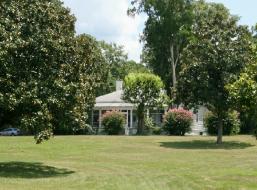
Dunlap House at Ocmulgee National Monument
149 years ago today, Union and Confederate forces battled at the Battle of Dunlap Hill (also called Dunlap's Farm) at Macon, Georgia.

It was at this battle that Stoneman's Raid, a Union military expedition designed to free the prisoners of war at Andersonville, Georgia, began to unravel. Gen. George H. Stoneman, whose name has been perpetuated in modern times in the lyrics of the song "The Night They Drove Old Dixie Down" would be captured two days later in a disaster that would rank as one of the worst cavalry defeats of the entire Civil War.

Gen. George H. Stoneman
Library of Congress
Stoneman's plan to raid the prisoner of war camps at Camp Oglethorpe in Macon and Camp Sumter at Andersonville was part of the Atlanta Campaign, which raged in the summer of 1864. The Union army of Gen. William Tecumseh Sherman and the Confederate army of Gen. John Bell Hood were engaged in brutal fighting that would determine the fate of Atlanta and in many ways that of the Confederacy itself. One week after Hood had struck out against Sherman at the Battle of Atlanta, Gen. Stoneman approached Sherman with an idea that might shatter Confederate hopes of holding Atlanta.

With 2,104 men and two pieces of artillery, Stoneman proposed that he make a lightning raid south from Atlanta, break the railroad to Macon by which the Confederates were bringing in supplies, and then liberate the thousands of Union prisoners of war being held at Macon and Andersonville.

Confederate Earthworks at Dunlap Farm
Sherman was wary of the idea, but ultimately decided that it was worth a try. He warned Stoneman, however, to focus first on breaking the railroad and not to try to reach the prison camps unless conditions on the ground looked very favorable. Stoneman rode out from Decatur on July 27, 1864, however, which his sights set clearly on Macon and Andersonville.

The Union raiders struck the railroad just as Sherman had ordered, but in the process gave Georgians a preview of the terror they would experience later that year during the March to the Sea. Homes, villages and farms were looted, livestock taken or killed, barns destroyed and civilians terrorized.

Gen. Howell Cobb
Library of Congress
Confederate cavalry fell back ahead of Stoneman's rampaging raiders, skirmishing as they did so. The skirmishing intensified as the head of the Union column approached Macon, with the Confederates showing strong indications that they were preparing to stiffen their spines and give Stoneman a battle as he approached the important city.  The Union general, however, overestimated his own capabilities and severely underestimated those of his waiting opponent, Maj. Gen. Howell Cobb.

Despite signs of stiffening Confederate resistances, Stoneman pushed into the outskirts of Macon on the morning of July 30, 1864, 149 years ago today.

Far from carrying out the lightning raid he had proposed to Sherman, the Union general had given his men too much time to loot and pillage as they came south. In doing so, he gave General Cobb's Confederates too much time to prepare for the coming battle.
Restored Blockhouse at Fort Hawkins

With the 5th Georgia Reserves, units fro the Georgia State Militia, volunteers and every other company he could find, Cobb prepared to defend Macon. Field artillery was placed on the grounds of old Fort Hawkins across the Ocmulgee River from downtown Macon.  Only the blockhouse of the old War of 1812 fort still stood, but Confederate officers used it as a lookout from which they could direct the fire of their guns.

The Confederate infantry took up position in trenches and field fortifications that guarded the approaches to Macon via the old Clinton Road. Much of the battle was fought on land belonging to the Dunlap family and soldiers battled each other on the grounds of the Dunlap House and virtually in the shadow of the massive prehistoric Indian mounds of the Macon Plateau.

The site of much of the fighting is preserved today as part of Ocmulgee National Monument in Macon, which focuses primarily on the massive and amazing prehistoric site. A trail and interpretive signage, however, tell visitors about the Battle of Dunlap Hill and provide access to the yards of the historic Dunlap House, which still stands, as well as the Confederate earthworks that can still be seen in its yard.

Nearby Fort Hawkins is now an archaeological park and although the blockhouse located there during the battle no longer stands, a recreation can be seen along with interpretive signage and other exhibits.

Cannonball House in Macon
In Macon itself, the famed "Cannonball House" is now a museum.  It was struck by a cannonball fired by Union troops as they shelled civilian areas of the city during the battle.

The Georgia reserves and militia fought much harder than Stoneman expected and it soon became clear that he would not take Macon and his dream of becoming the liberator of Andersonville would not be realized.  He ordered a withdrawal back from Macon, leaving the battlefield of Dunlap Hill in the hands of the Confederates.

The ordeal of the Union general and his 2,000 cavalrymen, however, was far from over. He had unleashed a hornet's nest on himself that would come down with full fury two days later at the Battle of Sunshine Church.  I'll post more about that on Wednesday.

To learn more about the Battle of Dunlap Hill, please visit www.exploresouthernhistory.com/dunlaphill.

Thursday, October 21, 2010

Battle of Dunlap Hill (Dunlap's Farm) - Macon, Georgia

On July 30, 1864, things began to go very wrong for Union General George Stoneman's raid into Middle Georgia when he came up against Confederate forces at the Battle of Dunlap Hill.

Also called the Battle of Dunlap's Farm, the engagement was fought to defend Macon from Stoneman's 2000+ Federal raiders.

Stoneman's Raid had begun on July 27th when he left Decatur, Georgia, for a move down the railroad from Atlanta to Macon and beyond. The Atlanta Campaign was then underway and the city had not yet fallen, but by cutting the railroad, Stoneman hoped to hasten its surrender. He also had convinced a somewhat skeptical General William Tecumseh Sherman to allow him to attempt a daring raid to free the tens of thousands of Union prisoners of war being held at Camp Oglethorpe at Macon and Camp Sumter at Andersonville.

Sherman cautioned Stoneman, however, not to attempt the extended raid if it seemed Confederate forces ahead of him were too strong. Stoneman, however, rode his mounted force directly into the jaws of waiting Confederate forces.

As he moved south toward Macon, he did put men at work breaking the railroad - although the damage would be quickly repaired by Southern workers - but also spread his men out to inflict as much destruction as possible. Homes were invaded and looted, innocent civilians terrorized, livestock stolen or killed, barns destroyed and as much other damage possible inflicted.  By the time the Federals reached the northern outskirts of Macon, however, the Confederates were waiting.

Despite a strong attack against Southern positions at Dunlap Hill and around the Dunlap House (now in Ocmulgee National Monument), the Union troops were unable to break through Confederate lines to secure the railroad bridge they had targeted. To make matters worse, they were unable to bring their own artillery to bear on Southern cannon firing on them from nearby Fort Hawkins. Instead, they opened on civilian targets in the city itself with their two 3-inch rifled cannon.

Stoneman finally withdrew, but he had ridden into a situation from which he would not escape. He surrendered two days later after the Battle of Sunshine Church.  To learn more about the Battle of Dunlap Hill, please visit www.exploresouthernhistory.com/dunlaphill.

Friday, March 13, 2009

Fort Hawkins - Macon, Georgia


Established in 18o6 by order of President Thomas Jefferson, historic Fort Hawkins stood on a high hill overlooking the historic Ocmulgee Old Fields and the site of what is now downtown Macon, Georgia.

Extremely well-built for a frontier outpost of the era, the fort consisted of blockhouses on diagonal corners connected by a rectangular stockade. Inside the stockade were various structures including barracks, an officers' quarters, etc.

Named for Colonel Benjamin Hawkins, the U.S. Agent to the Creek Nation, the fort served as a key post during the War of 1812 and the Creek War of 1813-1814. General Andrew Jackson visited the fort in February of 1818 as he led troops south to invade Florida during the First Seminole War.

Although it was not regularly garrisoned after 1819, Fort Hawkins remained an important landmark in the Macon area for many decades to come. One of the blockhouses was still standing at the site as late as the 1870s. The present blockhouse at the site is a reconstruction placed there during the 1930s and based on photographs and drawings of the original.

The site is now publicly owned and there are plans to develop it as a park. The reconstructed blockhouse can be seen on U.S. Highway 80 near the entrance to Ocmulgee National Monument in Macon. For more information, please visit www.exploresouthernhistory.com/forthawkins.


Thursday, March 12, 2009

Ocmulgee National Monument - Macon, Georgia

Ocmulgee National Monument preserves a major archaeological site of the Mississippian era located in what is now the eastern edge of the city of Macon, Georgia.

The Ocmulgee mounds, also called the "Ocmulgee Old Fields," are among the most impressive in the Deep South. The Great Temple Mound at the site is 55 feet high and overlooks a site that includes an array of other mounds and other unique Native American structures.

Established in around 900 A.D., the site was a major ceremonial and political center for an important chiefdom that flourished in the Macon area. At one time home to an estimated 1,000 people, the Ocmulgee site declined in importance in around 1100 A.D. and eventually was abandoned.

As evidence of their presence, however, the inhabitants of the site left behind a striking series of mounds and earthworks. One of the more fascinating structures was an earth lodge discovered by archaeologists as they began to investigate the mounds. Now reconstructed, the lodge was used for important council meetings and possibly religious ceremonies. Excavations revealed that special sets for 47 important leaders lined the circular wall of the structure, while an elevated platform built in the shape of a giant bird held three additional seats, undoubtedly used by the most important leaders of the town. Visitors can now enter the reconstructed lodge to see these original features.

To learn more about this important national park, please visit our new Ocmulgee pages at www.exploresouthernhistory.com/ocmulgeemounds1.

Friday, October 31, 2008

A Murderer's Ghost in Macon, Georgia

Unlike their counterparts of today, 19th century American newspapers often carried reports or assigned reporters to investigate ghost sightings and similar hauntings. As a result, they provide an interesting insight to many stories of the time.

An example is the 1885 report of a haunted house in Macon, Georgia.

According to widespread reports that year, a house in the community was haunted by the ghost of a man that had killed his wife before taking his own life. Neighbors reported seeing and hearing unusual things in the house and one former friend of the man even went to investigate.

To read the story of the "Murderer's Ghost of Macon, Georgia," please visit: www.exploresouthernhistory.com/maconghost.