Showing posts with label fort smith. Show all posts

Wednesday, July 17, 2013

The Battle of Honey Springs (Elk Creek), Oklahoma (July 17, 1863)

War-time Sketch of the Battle of Honey Springs, Oklahoma
150 years ago today on July 17, 1863, having skirmished with Confederate forces at Chimney Mountain, the Union army of Maj. Gen. James G. Blunt reached the battlefield at Honey Springs, Oklahoma. Please click here to read about the preliminary skirmish at Chimney Mountain.

Halting his men at the northern end of today's Honey Springs Battlefield State Historic Site, Blunt gave them time to rest while he and his escort scouted the position of Brigadier General Douglas H. Cooper's Confederate army.

Scene of Heavy Fighting early in the Battle
Although each general believed he was heavily outnumbered, their two effective forces were fairly close in size (about 3,000 men each). The Confederates had a few more men, but many never were engaged and all were experiencing problems with faulty ammunition. Under the rainy conditions that day quite often their guns would not fire.

As he arrived on the field, Blunt discovered that the Confederate army was positioned in thick brush and timber facing open ground across which his men would have to advance. Seeing that Cooper was prepared to fight, he ordered his men into the ranks:
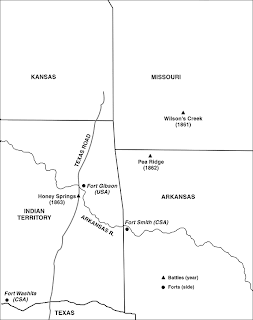
Map showing location of the Battle
Courtesy National Park Service
...After two hours' rest, and at about 10 a.m., I formed them in two columns, one on the right of the road, under Colonel [William R.] Judson, the other on the left, under Colonel [William A.] Phillips. The infantry was in column by companies, the cavalry by platoons and artillery by sections, and all closed in mass so as to deceive the enemy in regard to the strength of my force. In this order I moved up rapidly to within one-fourth of a mile of their line, when both columns were suddenly deployed to the right and left, and in less than five minutes my whole force was in line of battle, covering the enemy's entire front. - Maj. Gen. James G. Blunt, USA.

The Union force then moved forward, with skirmishers out front, and "soon drew their fire."

On the Confederate side of the field, General Cooper waited until the Union troops were within easy range and then opened on them with his artillery:

Elk Creek on the Honey Springs Battlefield
...I rode forward to the position north of Elk Creek where Captain [R.W.] Lee's light howitzer battery had been posted, and found it supported by Colonel Bass' regiment (Twentieth Texas Dismounted Cavalry), by a portion of the Second Cherokee  Regiment, and a body of skirmishers on the right, under command of Captain Hugh Trinn, of the First Cherokee Regiment, the remainder of the Cherokee Regiments being near the Creek. - Brig. Gen. Douglas H. Cooper, CSA.

Things quickly began to go wrong for the Confederates. General Cooper arranged his forces for a defense in detail, which allowed the Federal troops to put more power into position against his front lines. Col. Tandy Walker, meanwhile, mistook his orders and moved far out of position with his Cherokee and Creek troops.

Texas Road on the Honey Springs Battlefield
As Captain R.W. Lee and the men of his battery had watched, the Federals had begun to wheel 12 pieces of artillery into position. Rather than let them get this superior artillery force into position, Lee opened on the guns with his howitzers and a small experimental rifled cannon. A Union cannon was demolished by Confederate fire, but the Federals soon found the range and returned effect fire.

Heavy fighting erupted up and down the line but after two hours, the critical moment of the battle came. Confederate officers mistook a re-positioning of a portion of the Union line and thought a retreat had gun. They ordered an immediate counter-attack. The Confederates surged forward to within just 25 paces of the Union lines when the 1st Kansas Colored Volunteers suddenly unleashed a deadly volley on them. The charge was shocked to a stop as dozens of men fell dead and wounded.

Site of the Elk Creek Bridge on the Battlefield
At this point the Confederate line began to fall back for the crossings of Elk Creek and General Cooper ordered his men to withdraw. A force of Texas soldiers held the vital Elk Creek Bridge on the Texas Road under heavy fire, giving Cooper time to withdraw most of his men.

The Southern forces continued to fight, but their faulty ammunition caused so many problems that they began to lose hope. A retreat degenerated into a rout.

As total disaster seemed about to overwhelm the Confederate army, Col. Tandy Walker suddenly arrived on the field with his Cherokee and Choctaw soldiers. Cooper immediately ordered them to charge:

Site of Walker's Charge at Honey Spring
...With their usual intrepidity the Choctaws went at them, giving the war-whoop, and succeeded in checking the advance of the enemy until their force could be concentrated and brought up. The Choctaws, discouraged on account of the worthless ammunition, then gave way, and were ordered to fall back with the others in the rear of the train, which had moved off in an easterly direction, covered by our own troops.... - Brig. Gen. Douglas H. Cooper, CSA.

The "Gettysburg of the West" had been fought - and lost - by the Confederates and the end of the battle found them in full retreat for the Canadian River and the reinforcement column then coming up under General Cabell.  Cooper ordered his supplies that could not be saved set afire and by the time the Federals occupied their camps, there was little left to capture. General Blunt did report taking one piece of artillery, 200 stand of arms, 15 wagons and one stand of colors.

Monuments at Honey Springs Battlefield
The Battle of Honey Springs (sometimes called the Battle of Elk Creek) shifted the war in the far west from the Cherokee and Creek Nations all the way south into the Choctaw Nation. It opened the door for Blunt's capture of Fort Smith in September. Great misery would follow in the Creek, Choctaw and Chickasaw Nations as the Union troops pushed south over coming months and thousands of American Indian refugees would flee south for the Texas line, the smoke from their burning homes filling the skies behind them.

The battle will be reenacted in November, when the weather is a little cooler, and a major weekend of activities is planned for the 150th anniversary commemoration at the same time.

To learn more, please visit www.exploresouthernhistory.com/honeysprings1.


Wednesday, July 18, 2012

The Ozark Howler: Monster Cat in the Ozarks?

Ozarks of Arkansas
One of my favorite stories from my years of living in different parts of the South is the tale of the Ozark Howler in Arkansas. (It is also said to live in Missouri and Oklahoma, maybe even in Texas).
Now let me be clear from the start that this mysterious animal or beast or monster or whatever it is has been the focus of an incredibly large number of hoaxes and false reports. One hoaxer even admitted to a researcher that he spread as many false stories as he could to poke fun at the Chupacabra craze that swept through Texas a decade or so ago.

Small Waterfall in the Ozarks
That said, there are real stories from sincere eyewitnesses of a strange creature roaming through the Ozark Mountains. Its nightly cries are said to sound like a the screams of a woman.

I first heard reasonable eyewitnesses talk about the Arkansas Howler in 2004 when I was living in Fort Smith, Arkansas. Several people that I talked to who had seen or heard it or found its prints did not believe it to be a real "monster," but instead thought that a mountain lion or cougar was loose in the Boston Mountains that stretch between Fort Smith and Van Buren on the south and the booming Northwest Arkansas corridor.

Wildlife authorities maintained at that time that there were no native cougars left in Arkansas. Nevertheless, residents who lived in and along the fringes of the Boston Mountains, which are part of the Ozarks, were serious in their claims that a large animal was roaming their neighborhoods.


Cougar as seen in a USDA Photo
The most convincing evidence I saw during my time in Arkansas were photos from a trail cam belonging to a couple that lived north of Van Buren in Crawford County. The photos without doubt showed a large, tawny cat that looked just like a cougar to me. State wildlife officials did not dispute that it could be a big cat, they simply point out that there is no evidence of a breeding population of such animals in Arkansas.

Be that as it may, they do agree that there could be cougars or other large cats roaming the wild areas of the Ozarks, just believe that if they are there, they were someone's pets that either escaped or were released by their owners when they got too big and dangerous.

The Ozarks from White Rock Mountain
Now to be fair, other eyewitnesses claim to have seem something much more monstrous than a cougar in the hills and hollows of the Ozarks. Sightings ranging from a cat much bigger than a cougar to a cat-like monster with glowing eyes and horns growing from its head have been reported.

Whatever it is, and a recent investigation in Newton County, Arkansas, obtained plaster casts of what a biologist identified as possible Puma tracks (Puma is another name for a big cat like a cougar), the Ozark Howler is very much part of the modern folklore and tradition of the Ozarks.

To learn more, please visit www.exploresouthernhistory.com/ozarkhowler.

Monday, June 6, 2011

Real Rooster Cogburn worth remembering as True Grit comes out on DVD/Blu-ray

Cal Whitson, the Real Rooster Cogburn
I have mentioned him here before, but as the movie True Grit comes out on DVD/Blu-ray this week, it seems a good time to remember Cal Whitson, the man believed to have been the real Rooster Cogburn.

True Grit, first brought to the big screen by John Wayne, is the story of a young girl who enlists the help of a one-eyed Deputy U.S. Marshal from Fort Smith, Arkansas, to hunt down the man accused of murdering her father. The original book by Clinton Portis was something of a tongue in cheek portrayal of the heroes and outlaws in the Old West. But on the big screen, those same characters suddenly become larger than life. Whether in the original Wayne portrayal or in the new Jeff Bridges version, Rooster Cogburn leaps from the screen as the real deal, a rough and tumble frontier lawman with a deep sense of justice.

Although Portis said he based the character on a compilation of the deputy marshals who rode out from Fort Smith under the jurisdiction of the U.S. District Court of "Hanging Judge" Isaac C. Parker, there can be little doubt that Cal Whitson was the "real" Rooster Cogburn.

Cal Whitson had been a hard-fighting Union soldier during the Civil War and had lost an eye in battle in Arkansas. He became a deputy U.S. marshal in the years after the war after learning that his son had been killed while helping to apprehend an outlaw. He served in the Indian Territory, which fell under Judge Parker's jurisdiction, helping to bring wanted men back to Fort Smith to stand trial... and often stand on the gallows as well.

Parker hanged more men than any federal judge in U.S. history, but few know that he was opposed to the death penalty. Many of the laws governing crimes in the Indian Nations gave him only one sentence: death.

Cal Whitson, the real one-eyed deputy U.S. marshal of Fort Smith, was every bit as colorful and tough as the Rooster Cogburn of the movies. To learn more about him, please visit www.exploresouthernhistory.com/roostercogburn.

To learn more about Judge Parker's tenure as the "Hanging Judge" of Fort Smith, please visit www.exploresouthernhistory.com/ARFS6.

And if you haven't seen the new version of True Grit, I strongly recommend it. I am a huge John Wayne fan and love the original, but the new one tells the story in an entirely different way and is well worth viewing.

Sunday, December 12, 2010

The "Real" Rooster Cogburn?! - Fort Smith, Arkansas

The Real Rooster Cogburn?
With the coming release of the Hollywood remake of the classic movie "True Grit," one of the most beloved Western figures of all time is seeing a bit of a rebirth as well - Rooster Cogburn.

John Wayne won the only Academy Award of his career for playing the rough and tumble Deputy U.S. Marshal and now Jeff Bridges will take his turn at bringing the character from the pages of the 1968 novel "True Grit" by Arkansas writer Charles Portis. For the uninitiated, the book (and movies) tell the story of a young girl's quest to bring the man who murdered her father to justice in the court of Fort Smith's famed "Hanging Judge," Isaac C. Parker. She goes to Fort Smith, on the western border of Arkansas, from nearby Yell County and hires a man with "grit" - Deputy U.S. Marshal Rooster Cogburn. The two set out into the Indian Nations of what is now Oklahoma in search of the murderer.

Although Portis is a very reclusive man, he has been quoted in the past as saying that the character of Rooster Cogburn was actually created as a compilation of the men who served as Deputy Marshals for the U.S. Court for the Western District of Arkansas. And indeed, some of the events in the story he told were loose adaptations of real events involving several of these famed western lawmen.

There is strong circumstantial evidence - and perhaps a bit more than that - however, that the actual character of Rooster Cogburn was based on a real-life one-eyed Deputy U.S. Marshal from Fort Smith. Descendants of Cal Whitson, a man who served as a frontier lawman during the late 1800s, believe that their ancestor was the "real" Rooster Cogburn.

Whitson, like Cogburn, was a former Civil War soldier who served as a Deputy U.S. Marshal in Fort Smith during the days of the "Hanging Judge." He was the only such lawman in the history of Parker's court known to have lost an eye (his left, which he covered by keeping the brim of his hat intentionally pulled down on that side). And there is more.


To learn the story of Cal Whitson, the "real" Rooster Cogburn, please visit www.exploresouthernhistory.com/roostercogburn.

Monday, June 21, 2010

Belle Grove Historic District - Fort Smith, Arkansas


One of the most charming historic districts in the South can actually be found on what was once its western frontier.

Belle Grove Historic District in Fort Smith, Arkansas, coverd 22 city blocks and features an array of stunning historic structures spanning 130 years of Southern history. The numerous architectural styles on display in the district clearly demonstrate the city's historical claim to be the place "Where the Old South meets the Old West."

The John Rogers House, built in 1840 and thought to be the oldest house in Fort Smith, was patterned after the barracks of the old fort itself. Like many other homes in Belle Grove, it survived the violent years of the Civil War in the West and stands today as a landmark of Fort Smith's early history.

Nearby stands the unique Casper Reutzel House. Built using a half-timber and brick nogging design, it was completed in 1850 and was the home of Reutzel, who ran the most successful cotton shipping business on the Arkansas River. Another survivor of the Civil War, the house was loopholed for musketry.

Other structures in the Belle Grove Historic District include the Fort Smith Art Center (built in 1857 and used to quarter troops during the Civil War), the Bonneville House (built in 1870 and purchased in 1878 by the widow of Gen. Benjamin Bonneville, a famous Western explorer), the Clayton House (once the home of the District Attorney during the days of "Hanging Judge" Isaac C. Parker) and the Darby House (the boyhood home of Gen. William O. Darby, the father of the U.S. Army Rangers).

To learn more, please visit www.exploresouthernhistory.com/fsbellegrove.

Wednesday, January 20, 2010

The Restored Streetcars of Fort Smith, Arkansas


One of the most enjoyable historic sites in the South is actually one that moves. The Fort Smith Trolley Museum in Arkansas gives visitors to the historic city a chance to step back in time with a nostalgic ride on a 90-year-old electric streetcar.

For 50 years, streetcars provided transportation for the people of Fort Smith. The first three cars were mule drawn, but by 1890 they were replaced with electric streetcars. Initially platform cars that could make for a chilly ride during the winter, they initially were refined to become quite outstanding ways to travel.

The streetcars, often duplicated in style by modern trolleys seen in many cities, were powered by electricity and rolled along rails that once spread out into a web of more than 30 miles in and around downtown Fort Smith. They gave way to modern buses, however, and for nearly 60 years vanished from the landscape of the city.

Thanks to the hard work and efforts of volunteers and supporting individuals and businesses, however, a historic streetcar line has been brought back to life in Fort Smith. The beautiful old cars roll again along 1.5 miles of track in the historic frontier city.

To learn more, please visit www.exploresouthernhistory.com/ARFSTrolley.

Wednesday, January 13, 2010

Isaac C. Parker, the Hanging Judge of Fort Smith, Arkansas


The years following the Civil War were a time of great violence and turbulence in the Indian Nations of today's Oklahoma.

Hundreds of outlaws converged on the Nations, convinced they would be safe there from apprehension by law enforcement officers. They preyed on the innocent citizens of the Nations with impunity, also striking across the borders of Arkansas, Texas, Kansas and Missouri to rob, rape, murder and pillage.

To bring law and order to the region, a former militia officer and Congressman from Missouri was named the U.S. District Judge for the Western District of Arkansas. His name was Isaac C. Parker and he became remembered in Western lore and legend as the "Hanging Judge" of Fort Smith.

Parker recruited a brave and daring team of deputy U.S. marshals who rode far and way through the frontier region to bring justice to the unfortunate people preyed upon by the outlaw gangs. These lawmen were memorialized on the big screen in such films as "True Grit" and "Rooster Cogburn" starring John Wayne and "Hang Em High" starring Clint Eastwood. The Hanging Judge was a key figure in all three of those films, as well as in many others.


Parker earned his legendary title because he sent more than 70 outlaws to the gallows in Fort Smith, more than any other Federal judge in U.S. history. Most people do not know, however, that the judge was actually an opponent of capital punishment. Parker didn't believe that it stopped crime, but he imposed the sentences because under Federal law of the time, death was the only legal sentence for many of the crimes tried in his court. Modern generations have also all but forgotten that more than 60 of Judge Parker's officers lost their lives in the line of duty.

The legend of Judge Isaac Parker remains very much alive in the charming and historic city of Fort Smith today. His gallows have been reconstructed and numerous artifacts from the judge's battles against such outlaws as the Dalton gang, the Rufus Buck gang, Cherokee Bill and even Belle Starr can be seen today at Fort Smith National Historic Site. To learn more, please visit www.exploresouthernhistory.com/ARFS6.

Monday, July 27, 2009

145th Anniversary of the Battle of Massard Prairie, Arkansas


Today marks the 145th anniversary of the Confederate victory at the Battle of Massard Prairie, Arkansas.

Fought on July 27, 1864, the battle took place in what is now the southeastern quadrant of the important city of Fort Smith, Arkansas. Confederate forces led by Brigadier General Richard Gano and composed of both white and Native American soldiers swept down from nearby ridges and destroyed a full battalion of the 6th Kansas Cavalry in one of the great open field charges of the Civil War.

The battle, along with a second attack a few days later, was instrumental in driving Union troops into the primary fortifications at Fort Smith and eliminating their ability to effectively scout the movement of Confederate forces in the region. As a result, Southern troops were soon able to cross the Arkansas River and push north through the Cherokee Nation to achieve their dramatic victory at the Battle of Cabin Creek, which resulted in one of the greatest seizures of Union supplies by Confederate forces during the entire Civil War. The Battle of Massard Prairie opened the door for the major victory.

Although small when compared to many other battles of the war, Massard Prairie was significant for a number of reasons. In addition to creating the opportunity for the victory at Cabin Creek, it also marked one of the last great cavalry charges in American history. Confederate troops charged on horseback across miles of open prairie to achieve their victory. It was included one of the few documented instances of Union forces scalping Confederate dead after a battle. And finally, it deprived the Union troops at Fort Smith of desperately needed horses while providing Confederate forces with modern weaponry that would prove instrumental in coming actions.

The site is now marked by Massard Prairie Battlefield Park near the intersection of Red Pine and Morgan in Fort Smith. The park features a walking trail across the site of some of the key fighting, a memorial flag staff and a small monument. To learn more, please visit www.exploresouthernhistory.com/massardindex or consider purchasing my book, The Battle of Massard Prairie, available now at www.amazon.com or at Prairie Grove Battlefield State Park in Northwest Arkansas.

Friday, December 19, 2008

Battle of Massard Prairie now available thorugh Amazon


The Battle of Massard Prairie: The 1864 Confederate Attacks on Fort Smith, Arkansas is now available through Amazon.com.
The book was published last spring but became available on Amazon this week and can still be delivered in time for Christmas. To order just follow the link above and search for "battle of massard prairie."
This book tells the story of one of the few overwhelming Confederate victories in Arkansas. Fought on the open prairie outside Fort Smith on July 27, 1864, the battle involved one of the great open field cavalry charges of the Civil War, documented instances of Union troops scalping Confederate dead and the virtual destruction of an entire battalion of the 6th Kansas Cavalry.
To learn more about the battle, please visit www.exploresouthernhistory.com/massardprairie.

Wednesday, August 13, 2008

Battle of Massard Prairie Book now available at Fort Smith Museum of History


Paperback copies of The Battle of Massard Prairie: The 1864 Confederate Attacks on Fort Smith, Arkansas are now available at the Fort Smith Museum of History in downtown Fort Smith.
The museum is located at the western end of Rogers Avenue across from the Fort Smith National Historic Site and is open daily from Tuesday through Saturday. As of yesterday they had a full supply of autographed copies of the book.
The book explores the 1864 Confederate attacks that resulted in the Battles of Massard Prairie and Fort Smith. The two actions were important preliminaries to the highly successful Second Cabin Creek Expedition in present-day Oklahoma, one of the most successful Confederate raids of the Civil War.
Proceeds from the books benefit the Cane Hill Battlefield Driving Tour project in Northwest Arkansas and the Fort Smith Museum of History.
They are also available for sale at Prairie Grove Battlefield State Park in Northwest Arkansas and can be purchased online at www.exploresouthernhistory.com/dalecox.
If you would like to read more about the Battle of Massard Prairie, please visit www.exploresouthernhistory.com/massardprairie.

Friday, April 18, 2008

New Book Released: The Battle of Massard Prairie


I'm pleased to announce the publication of my latest Civil War book, The Battle of Massard Prairie.

The book explores the history of a fascinating battle that took place on the outskirts of Fort Smith, Arkansas on July 27, 1864.

The Battle of Massard Prairie was one of the most dramatic Confederate victories of the Civil War in Arkansas and was especially significant because: 1) it included a mass cavalry charge across miles of open ground, 2) white and Native American Confederate soldiers fought side by side and 3) it resulted in one of the few documented cases of Union soldiers scalping Southern dead.

This book was completed a little over one year ago and is being published by Yuchi Heritage of Florida. The profits are being donated to various historic preservation efforts. 50% will go to the development of a new Driving Tour of the Cane Hill Battlefield in Arkansas and the rest will go to other worthwhile projects.

The book is available now at http://www.exploresouthernhistory.com/ (just look for the Battle of Massard Prairie heading), where you can also learn more about the battle. It will be available at the gift shop of Prairie Grove Battlefield State Park in Arkansas in 7-10 days and will begin to pop up on the various online bookstores over the next month or so. Additional locations will be announced soon.

Tuesday, August 21, 2007

Robbers Cave State Park - Oklahoma


Robbers Cave State Park is one of my favorite places in the South. Located near the town of Wilburton in eastern Oklahoma (about an hour or so southwest of Fort Smith, Arkansas), the park is nestled in the beautiful Sans Bois Mountains.


Noted for its scenic beauty, the park has a lake, bluffs, caves, unusual rock formations and more. It is a popular place for sightseeing, hiking, picnicking, camping, swimming and more. The park also offers cabins, a lodge, a restaurant and more.


For history buffs, though, Robbers Cave State Park offers a chance to explore a little of the history of the Old West. The caves and ravines in the park were said to be hideouts for a number of notorious outlaws during the "gunfighter" days following the Civil War. Among the names linked with the park are those of Jesse James and Belle Starr. James, Starr and other outlaws are said to have used the park area as a hideout to avoid capture by Deputy U.S. Marshals hoping to bring them to justice at the court of "Hanging Judge" Isaac C. Parker in Fort Smith.


It is worth noting that in the main cave at the park can be seen a carving dating from 1877, the ideal time for the area to have been used by "Old West" outlaws.


To see more photographs and learn more about Robbers Cave State Park, please visit our Robbers Cave pages at: http://www.exploresouthernhistory.com/okrobberscave.html.