Tuesday, April 12, 2011

The Bombardment of Fort Sumter - 150 Years Ago Today

Fort Sumter National Monument
NPS Photo
At 4:30 a.m. on April 12, 1861, 150 years ago today, a mortar shell rose high in the air over Charleston Harbor in South Carolina and exploded. As the flames and fragments rained down on the island citadel of Fort Sumter, the men of both sides knew that the War Between the States had begun.

One by one, Confederate cannon ringing the harbor opened fire. Inside the brick fortress, U.S. soldiers hunkered down as shot and shell impacted with the masonry and shook the ramparts to their foundations. They would eventually return fire, even targeting a hotel where Captain Abner Doubleday claimed he had once received poor service, but remarkably no one would die on either side.

42-Pounder at Fort Sumter
The Bombardment of Fort Sumter continued for 34 straight hours. Sections of wall well away and the wooden parts of the fort, particularly the barracks, caught fire. Dense smoke settled over the fort and the men inside held wet clothes over their noses and mouths so they could breathe and continue to fight. Some of them had fought in the War with Mexico or in the Seminole Wars, but they had never experienced anything like this.

In Charleston, citizens gathered on the rooftops and watched from the Battery as the shot and shells arced over the harbor. Each explosion brought cheers. South Carolina had waited a long time for this day.

Among the Confederate commanders, there were mixed emotions. Their duty was not so much to the new country that had been formed in Montgomery, Alabama in February of 1861 as it was to their home states and to their mutual identity as Southerners. But they had served with Major Robert Anderson and many of the other men in Fort Sumter, had shared good times and danger together, and they regret mixed with exhiliration that the long-awaited battle was finally underway.

Fort Sumter
Knowing that his position was hopeless but that his duty was to defend the flag of his nation, Major Anderson held out against all odds. Even though his position was under fierce attack, he did his best to preserve the lives of his officers and men. He ordered them not to man the fort's upper level of guns where they would be more exposed to the Confederate fire, although in the midst of the bombardment a soldier defied those orders and dashed up the stairs and touched off the cannon there.

Fort Sumter would surrender on the next day, April 13, 1861. More than 600,000 men would die and more than 1,000,000 would be wounded before Anderson would again raise his flag over the walls of Fort Sumter.

To learn more about Fort Sumter National Monument, which preserves the ruins of the historic fort, please visit www.exploresouthernhistory.com/fortsumter.

Friday, March 25, 2011

The Athens Double-Barrelled Cannon - Athens, Georgia

The Double-Barrelled Cannon
It was a "secret weapon" of the Confederacy that wasn't all that secret: a double-barrelled cannon that its designer hoped would become the ultimate anti-personnel weapon of the Civil War.

The famed Athens Double-Barrelled Cannon now rests on the grounds of City Hall in the North Georgia city and - besides the Georgia Bulldogs - is perhaps the most photographed attraction in Athens.

A Civil War Landmark
Cast in 1862 at the Athens Foundry, the cannon was designed by John Gilleland, a home builder and home guard private. He envisioned a weapon that would fire a load that could best be described as "extended chain shot." Parallel barrels fired two 6-pound iron balls simultaneously. The barrels of the gun diverged by about 3 degrees, allowing the balls to spread out as they emerged from the double muzzle. An 8-foot iron chain connected the cannonballs and as they were fired, the entire load was expected to begin spinning and cut an 8-foot wide swatch through any attacking enemy infantry force.

Local legend holds that the gun didn't work as expected. It is said that it was impossible to fire the twin barrels simultaneously and that the chain broke in the test firing causing the balls to speed off in different directions, killing a cow, destroying a chimney and demolishing a field of corn.  War-time accounts, however, indicate that the cannon might have been more effective than is traditionally thought.

To read more and learn about the Athens Double-Barrelled Cannon, please visit www.exploresouthernhistory.com/athenscannon.

Sunday, March 20, 2011

Ten Favorite Spring Destinations in the South

Muskogee Azalea Festival
Today is the first day of Spring, so I thought I would share with you ten of my favorite Southern spring destinations. Some of these are well known and some are off the beaten path, but all are well worth a visit.
Maclay Gardens
  1. 2011 Muskogee Azalea Festival in Muskogee, Oklahoma. One of the finest events of its kind in the South, the annual festival draws in tens of thousands of visitors from around the world. Held Show alleach April at Honor Heights Park in Muskogee, the festival gives visitors the chance to roam through an amazing setting that features more than 30,000 blooming trees and plants representing more than 625 varieties. To learn more and see a schedule of this year's event, please visit www.exploresouthernhistory.com/okmuskogeeazalea.
  2. Maclay Gardens State Park in Tallahassee, Florida. Now in bloom, Maclay Gardens is one of the most beautiful Spring settings in the Sunshine State. Located in Florida's historic capital city, the park features a magnificent garden of azaleas, dogwoods, redbuds and other blooming trees and plants that was developed over decades beginning in 1923. Listed on the National Register of Historic Places, the gardens are open daily. To learn more, please visit www.exploresouthernhistory.com/maclaygardens1.
  3. Callaway Gardens in Pine Mountain, Georgia. One of the South's premier attractions, Callaway Gardens covers 16,000 acres on the slopes and valleys adjoining Georgia's historic Pine Mountain. Established to revitalize overworked fields where its founders discovered a rare native azalea plant growing, the gardens are simply magnificent. To learn more, please visit www.exploresouthernhistory.com/callawaygardens1.
  4. Eufaula, Alabama. A beautiful, historic city on the Chattahoochee River in southeastern Alabama, Eufaula is known for its stunning spring blossoms and magnificent historic homes. Its Annual Spring Pilgrimage is one of the finest such events in the South and will take place on April 1st through 3rd this year. To learn more, please visit www.exploresouthernhistory.com/eufaula.
  5. Garvan Woodland Gardens in Hot Springs, Arkansas. A world class botanical garden covering 210 acres on a peninsula that extends into Lake Hamilton, Garvan Gardens are magnificent year round, but take on amazing beauty during the spring. The gardens feature winding paths that lead through stunning arrays of flowering trees and plants and past waterfalls and many other unique features. Much like Callaway Gardens in Georgia, Garvan Gardens were begun to restore a setting to its natural beauty. To learn more, please visit www.exploresouthernhistory.com/garvingardens.
  6. Natchez Trace Parkway in Mississippi, Alabama and Tennessee. A winding national park area that extends from Natchez on the Mississippi River to the outskirts of Nashville, Tennessee, the Natchez Trace is another "must see" Southern destination. It takes drivers through 444 miles of beautiful scenery, rich in the natural spring color of dogwoods, redbuds, wild plum and other native varieties. The parkway also passes scores of historic sites and points of interest. To learn more, please visit www.exploresouthernhistory.com/natcheztrace1.
  7. Rosedown Plantation State Historic Site in St. Francisville, Louisiana. The National Park Service describes Rosedown as one of the best preserved antebellum plantation complexes in the United States. In addition to the magnificent main house and other historic structures, the historic site preserves one of the largest private gardens of the 19th century. Covering 28 acres, the gardens feature winding paths, summer houses, fountains and an amazing array of blooming plants. To learn more, please visit www.exploresouthernhistory.com/rosedown.
  8. Dogwood Canyon Nature Park near Branson, Missouri. Covering 10,000 acres of Ozark mountain country on the border of Missouri and Arkansas, Dogwood Canyon is offers spring beauty of the wilder variety. The trams and bike paths take visitors through a beautiful valley rich in redbuds, dogwoods and other blooming trees. The park also features trout streams, historic sites, magnificent waterfalls and even herds of American bison (buffalo) and elk. To learn more, please visit www.exploresouthernhistory.com/dogwood1.
  9. Rainbow Springs State Park in Dunnellon, Florida. Once a privately-owned amusement park enjoyed by untold millions of visitors over the years, Rainbow Springs is now the focal point of a state park not far off Interstate 75 in the charming town of Dunnellon, Florida. In addition to the magnificent main spring, the park preserves some of the original gardens with their azaleas, waterfalls and other points of interest. It is also one of the state's most affordable destinations, with an entrance fee of only $2 per person or $5 per vehicle of up to 8 people. To learn more, please visit www.exploresouthernhistory.com/rainbowsprings.
  10. Waterfalls of Alabama. Although it has been a bit dry so far this spring, many of Alabama's beautiful waterfalls are running well. The state features some of the prettiest falls in the South, a number of which are easily accessible. The premier ones include Noccalula Falls in Gadsden, DeSoto Falls at Mentone and Little River Falls near Fort Payne. To learn more, please visit www.exploresouthernhistory.com/alabamawaterfalls.
You can also learn about hundreds of other unique Southern historic sites, natural wonders and points of interest at www.exploresouthernhistory.com.

Saturday, March 19, 2011

Audubon Pilgrimage - St. Francisville, Louisiana

Rosedown in St. Francisville
The annual Audubon Pilgrimage is underway this weekend in St. Francisville, Louisiana.

A charming community that was once the capital of the short-lived "Republic of West Florida," St. Francisville is located atop a high ridge overlooking the Mississippi River at the intersection of U.S. Highway 61 and Louisiana Highway 10. The town is 30 miles north of Baton Rouge and 60 miles south of Natchez, Mississippi.

St. Francisville is well known because it is surrounded by some of the most beautiful surviving plantation homes in the South. There is Rosedown Plantation, considered one of the country's finest surviving antebellum plantation complexes by the National Park Service; Oakley Plantation, where famed naturalist John James Audubon painted many of his best known bird paintings and The Myrtles, considered by some to be America's most haunted home. Also just south of town is Port Hudson State Historic Site, scene of a bloody Civil War battle and siege.

The annual Audubon Pilgrimage features a full weekend of events, including tours, live music, candlelight graveyard tours, a noted antique show and sale and much more. To learn more about St. Francisville and the Audubon Pilgrimage, please visit www.exploresouthernhistory.com/stfrancisville.

Friday, March 11, 2011

Oklahome to close Heavener Runestone State Park (Updated with news that the park remains open)

Heavener Runestone
Note: The park remains open thanks to the city of Heavener stepping up to save it. It is now operated as a municipal park and is open daily, so stop by and visit when you can!


The Oklahoma Tourism and Recreation Department has announced plans to PERMANENTLY close seven state parks, including Heavener Runestone State Park.

The announcement from the department indicates that the closures will take effect on August 15th and result from budget cutting plans. Other parks slated for closure are Adair State Park in Stilwell; Beaver Dunes in Beaver; Boggy Depot in Atoka; Brushy Lake in Sallisaw Lake Eucha in Jay; and Wah-Sha-She in Copan. The measure will eliminate only 10 full-time positions and save the department around $700,000, but the economic impact on the communities affected could be tremendous.

Waterfall near the Runestone
Heavener Runestone State Park alone, for example, annually attracts around 100,000 people to eastern Oklahoma. The loss of this visitation will have a tremendous economic impact on Heavener and other local communities, reducing sales for merchants and tax collections for the state.

The park, which occupies a beautiful setting on the top of Poteau Mountain, takes its name from unique carvings found on a large boulder there. The characters have been identified as Norse runes, but there is debate over their age and authenticity. A solid core of believers think they provide evidence that Viking explorers came up the Mississippi and Arkansas Rivers hundreds of years ago and made their way as far as eastern Oklahoma. Others believe they are forged. Still others believe they are of more recent origin, but were not intended as a forgery but simply to add character to the ravine where the boulder was found.

Although there are some variations, most believe that the runes spell out either "Glomesdal" or "Gnomesdal." Roughly interpreted, this would mean either "Valley of Glome" or "Valley of the Gnomes." I tend to favor the latter interpretation, as the ravine is quite beautiful and brings to mind stories of mythical creatures like gnomes and fairies. Others believe that "Glome" could have been an early Norse explorer who settled in the region. Several other smaller runestones have been found around the area.

Heavener Runestone State Park
I'll confess that the lack of other artifacts causes me some serious doubts about the ancient Vikings theory, but I have visited the state park many times and it is one of the most beautiful spots in all of Oklahoma. Located atop a mountain, it provides spectacular views of the surrounding countryside, beautiful and rugged hiking trails, mountaintop picnicking, spring waterfalls and more. They mystery surrounding the Heavener Runestone adds a great deal of charm to the setting, which is well worth being preserved as a cultural landmark, whatever the truth behind it.

The land for the park was donated to the state and would revert back to the heirs of the original owners if the park is closed, so the state would gain very little from closing this park, which is extremely popular with visitors from around the region who come to enjoy the setting, as well as tourists who come from far and wide to see the famed runestone.

You can read more about the park and see additional photos at www.exploresouthernhistory.com/heavener1.

Wednesday, March 9, 2011

"The Battle of Marianna, Florida" - Expanded Edition now available!

I'm pleased to announce that the Expanded Edition of my book, The Battle of Marianna, Florida, is now available.

The new Expanded Edition includes nearly 50 pages of additional information as well as maps, new photographs, expanded casualty lists, bibliography and other features not included in the original. It also offers a much more detailed accounting of the battle and the 1864 raid across Northwest Florida.

The Battle of Marianna was fought on September 27, 1864, at the climax of the deepest penetration of Confederate Florida by Union troops during the entire Civil War. Leaving Pensacola Bay on September 18th and led by Brigadier General Alexander Asboth, a column of 700 mounted Union solders devastated the populated areas of Walton, Holmes and northwestern Jackson Counties before reaching Marianna on the 27th.

The battle was one of the fiercest small engagements of the war. By the time it was over, nearly 20% of Marianna's male population had been taken prisoner and the bodies of killed and wounded men stretched from one side of the town to the other. A sharp street fight waged between bodies of both cavalry and infantry, the battle is sometimes known as "Florida's Alamo." Many of the participants were seasoned veterans and those who left accounts almost all agreed that it was the fiercest battle of its size they encountered during the entire war.

The new book includes expanded detail on the route of the troops to and from Marianna along a path that was longer in miles than Sherman's March to the Sea. It also includes an expanded narrative of the battle itself as well as new sources on the smaller fights at Eucheeanna, Campbellton and Vernon that took place as the Union column moved through the Florida panhandle.

The new book is now available by clicking the ad at the top of this post. Signed copies can be obtained through Chipola River Book and Tea in Marianna (on Lafayette Street across from the Battle of Marianna Monument). The book is also available in electronic format as a download for the Amazon Kindle reader device or the free Kindle software for computer or smart phone.

To read more about the battle, you can also visit www.battleofmarianna.com.

Wednesday, March 2, 2011

Reenactment of the Battle of Natural Bridge, Florida set for this Weekend

Natural Bridge Battlefield
The 146th anniversary of the Battle of Natural Bridge will be commemorated this weekend with a reenactment and other activities at Natural Bridge Battlefield Historic State Park near Tallahassee, Florida.

Fought on March 6, 1865, the battle was one of the last significant Confederate victories of the Civil War. It preserved Tallahassee's status as the only Southern capital east of the Mississippi not captured by Union troops, kept the small port of St. Marks open to blockade runners and prevented the economic destruction of an important area of North Florida and South Georgia by Federal forces. It came just five weeks before General Robert E. Lee surrendered the Army of Northern Virginia at Appomattox Court House, Virginia.

The Battle of Natural Bridge resulted from a major amphibious assault by Union troops. Moving up the Gulf of Mexico from posts at Key West and Cedar Key, U.S. transport steamers arrived off the mouth of the St. Marks River in late February of 1865. Joined there by a large flotilla of Union warships, the steamers held position while General John Newton and his officers developed their plans.

Confederate Earthworks at Natural Bridge
During the first week of March, demolition parties were sent ashore to destroy railroad bridges east and west of Tallahassee and then the navy began the difficult task of bringing the main body of Newton's command to shore at the St. Marks Lighthouse south of Tallahassee. The amphibious night landing was hampered by shallow water and darkness, but the men finally got ashore and started inland. The warships, meanwhile, began a move up the St. Marks River to engage Confederate batteries and put ashore hundreds of sailors who were to serve as additional infantry during the expedition.

The naval side of the expedition was a complete failure, due to difficulty encountered navigating the narrow twisting river channel. Things went even worse for the land force. Despite eight courageous charges, the Union troops (composed primarily of the 2nd and 99th USCT regiments) were handed a bloody defeat at the Battle of Natural Bridge.

To learn more about this unique and often overlooked battle, please consider the expanded edition of my book, The Battle of Natural Bridge, Florida (also available as a Kindle download). You can also learn more and access a  schedule of this weekends events at www.exploresouthernhistory.com/nbindex.

Saturday, February 26, 2011

Rosedown Plantation State Historic Site - St. Francisville, Louisiana

Rosedown Plantation State Historic Site
One of the best known and most beautiful of the South's historic antebellum plantation homes, historic Rosedown Plantation in St. Francisville has been a Louisiana landmark since 1834.

Named after a play its builders, Daniel and Martha Barrow Turnbull, saw on their honeymoon, Rosedown is now a state historic site and is open to the public year-round. In addition to preserving one of the finest collections of antebellum plantation structures in the nation, the park also preserves Rosedown's magnificent gardens which also date from the antebellum era.

Construction of the main house at Rosedown began in 1834. Framed by a beautiful avenue of live oaks, the facade of the Federal-Greek Revival style home is one of the most recognized in the South. Other surrounding plantation structures, including a doctor's office, kitchen, etc., were built in similar styles and many survive today.

Gardens at Rosedown Plantation
Rosedown's magnificent gardens date back to at least 1836, when Martha Turnbull made the first entry in her "garden diary" that survives today. Over the decades that followed she created one of the largest private gardens of the 19th century, importing exotic plants from Asia and other overseas destinations. Rosedown, in fact, was the site of one of the first known plantings of camellias in America and blooms from the original stock can still be seen there. The 28-acre gardens are also known for their azaleas and other beautiful flowering plants.

Camellia at Rosedown
The Turnbull family continued to live at Rosedown throughout the Civil War, despite the terrible violence that took place within earshot of the home during the Siege and Battle of Port Hudson. The home was not damaged during the shelling of St. Francisville by Union warships, although the arrival of Federal forces in the area meant freedom for the more than 100 slaves who lived and worked on the farm. After its fall in July of 1863, nearby Port Hudson became a major recruiting and training center for African American soldiers who came from area plantations to join the Union army.

Rosedown survived, however, and today is one of the most beautiful of the numerous historic plantations that line the Mississippi River from Natchez down to St. Francisville. To learn more, please visit www.exploresouthernhistory.com/rosedown.

Tuesday, February 22, 2011

Port Hudson State Historic Site - Zachary, Louisiana

Confederate Earthworks at Port Hudson
Although its story is often overshadowed by that of the Battle of Vicksburg, which took place at the same time, the Siege and Battle of Port Hudson was one of the monumental confrontations of the Civil War.

After a failed attempt to retake Baton Rouge in August of 1862, Confederate forces in Louisiana withdrew about 30 miles up the Mississippi River to Port Hudson. A small community located atop high bluffs overlooking a bend of the river, Port Hudson offered the ideal place for a citadel to prevent Union warships from reaching the vital junction of the Mississippi and Red Rivers.

Garrison Flag that flew over Port Hudson
Over the months that followed, the position was heavily fortified and by early 1863 a Confederate force of around 7,500 men held the position and manned the heavy guns that aimed down on the channel of the Mississippi. A flotilla of Union warships commanded by Admiral David G. Farragut tried to blast its way past Port Hudson on March 14, 1863, but only two of the vessels made it. The U.S.S. Mississippi was destroyed and the other ships had to turn back. Port Hudson had proved its worth as a defensive position.

Cannon at Port Hudson, Louisiana
Determined to eliminate the Confederate bastion, Union General Nathaniel P. Banks moved against it with more than 30,000 men in May of 1863. The severely outnumbered Confederates dug in even deeper and devastated the Union army in its two major attempts to storm the works. An attack on June 14, 1863 went so bad for the Federals that they suffered casualties of 1,792 men compared to only 47 of the Confederates, giving Southern General Franklin Gardner one of the most lopsided tactical victories of the Civil War.

Port Hudson held out until after the fall of Vicksburg, Mississippi, in July of 1863. The fall of that city gave Union ships coming down the Mississippi access to the river's confluence with the Red River and there was no longer any reason for the Confederates in Louisiana to continue to hold out. Gardner surrendered on July 9, 1863, having withstood until then the longest total siege of the Civil War.

To learn more about the Siege and Battle of Port Hudson and to see photos of Port Hudson State Historic Site and other points of interest in the area, please visit www.exploresouthernhistory.com/porthudson.

Thursday, February 17, 2011

Oakley Plantation (Audubon SHS) - St. Francisville, Louisiana

Oakley Plantation
Built in around 1806, Oakley Plantation at Audubon State Historic Site has been a Louisiana landmark for more than 200 years.

Built with clear West Indian influences, the house dates from the days when the Florida Parishes of Louisiana were still part of Spain. Oakley was still new in 1810 when the territory east of the Mississippi, south of the 31st parallel, north of Lake Pontchartrain and Gulf of Mexico and west of the Perdido River rebelled against the Spanish and declared its independence. The Republic of West Florida, so named because it was part of colonial West Florida and not present-day West Florida, lasted for only three months before it was taken over by the United States.

Footpath at Oakley Plantation
Oakley Plantation's best known interaction with history, however, came in 1821 when famed naturalist John James Audubon was hired by Mr. and Mrs. James Pirrie, the plantation owners, to teach drawing to their daughter Eliza. Although he remained there only a few months, the plantation became a landmark location in the life and career of Audubon because it was here that he began work on 32 of his famed paintings of North American birds. He was so taken with the farm and its surroundings, in fact, that he described its beauty as "almost supernatural."

Oakley Plantation is now preserved at Audubon State Historic Site on the outskirts of St. Francisville, Louisiana. To learn more, please visit www.exploresouthernhistory.com/audubon.

Sunday, February 6, 2011

Grave of the best known Private Soldier of the Confederacy - Milledgeville, Georgia

Private Edwin F. Jemison, 2nd Louisiana Infantry
A stone monument at Memory Hill Cemetery in historic Milledgeville, Georgia, bears a name that touches the heart of many who read about or study the Civil War: Edwin F. Jemison.

Jemison was a 16 year old volunteer in Louisiana when the haunting photograph that many consider the best known image of a private soldier of the Confederacy was taken. He never saw his 18th birthday.

Born into a prominent Georgia family, Edwin F. Jemison (who signed his military papers as E.F. Jemison) was a descendant of early Quakers who had founded the town of Wrightsboro, Georgia, and was the great-grandson of a hero of the American Revolution. His family had moved to Louisiana from Georgia during the 1850s and had acquired large holdings in the Monroe area. When President Abraham Lincoln called for hundreds of thousands of volunteers to put down the rebellion in the South, Jemison was among the Southern men and boys who turned out to defend their homeland.

Grave of Edwin F. Jemison
Edwin F. Jemison was mustered into the 2nd Louisiana Infantry Regiment on May 11, 1861, and served in Companies I, B and C during his 12-months tour of duty. Possibly because of his young age, he was detached early in his service to assist at the headquarters of General John B. Magruder. By the winter of 1861-1862, however, he was in the ranks in Virginia where the 2nd Louisiana had been sent to defend the Confederate capital city of Richmond.

Only 17 years old, he was shot down when his regiment stepped out in one of the human waves sent by General Robert E. Lee against Union artillery positions at the Battle of Malvern Hill on July 1, 1862. His sad eyes, however, stare out through the years to remind us of the cost of war thanks to the 150 year old photograph that has been widely reprinted since the war.

A monument to Jemison was placed in the family plot at Memory Hill Cemetery in Milledgeville soon after the war and visitors today can view his grave and read an interpretive panel that tells his tragic story. To learn more, please visit www.exploresouthernhistory.com/jemison.

Friday, February 4, 2011

The Confederate States of America was formed 150 Years Ago Today

Alabama State Capitol Building
On February 4, 1861, delegates from the seven Southern states that had declared their independence from the Union met in Montgomery, Alabama, and declared the existence of a new nation, the Confederate States of America.

The meeting took place at the historic Alabama State Capitol Building, which also would serve as the first capitol of the Confederacy. As the delegates convened in the magnificent old building, they declared themselves a provisional legislature for the new Southern nation and authorized a committee to begin work on drafting a Constitution that would unify the seceded states for their common defense and welfare.

First Capitol of the Confederacy
The move would set the stage for the largest conflict of arms ever to take place on the North American continent. The new Southern nation defied the will of the old Union and attempts at negotiation to resolve the difference between the two governments would fail. It would be from Montgomery, two months later, that President Jefferson Davis would issue the order for Confederate guns to open fire on Fort Sumter. That attack would officially open the War Between the States or Civil War. By the time the war came to an end, the history of the United States and its people would be forever changed.

The historic Alabama Capitol Building which served as the First Capitol of the Confederacy remains in use today. It stands atop Goat Hill at the end of Dexter Avenue and has looked out on an amazing array of monumental historical events, from the formation of the Confederacy and beginning of the Civil War to the end of the Selma to Montgomery March during the Civil Rights Movement.

To learn more about the building's role as the First Capitol of the Confederacy, please visit www.exploresouthernhistory.com/montgomerycapitol1.

Thursday, February 3, 2011

Two Florida Civil War Battlefields facing Possible Closure

Olustee Battlefield
With the 150th anniversary observation of the Civil War now underway and tourists flocking to Civil War sites across the nation, the Florida Department of Environmental Protection (DEP) is considering locking the gates to the only two state-owned Civil War battlefields.

Olustee Battlefield Historic State Park and Natural Bridge Battlefield Historic State Park are among 53 parks and historic sites DEP is considering closing to save $6.5 million from the agency's $1.5 BILLION budget. The cut would represent the closing of one-third of Florida's state parks and historic sites while barely impacting DEP's massive budget.

Olustee Battlefield Historic State Park (just east of Lake City) preserves the scene of the February 20, 1864 engagement that was the largest Civil War battle in Florida. The Battle of Olustee was a massive Confederate victory that preserved the supply lines providing beef and other food for Southern armies and stopped a Union plan to restore the allegiance of at least part of the state in time for its electoral votes to be counted in the 1864 Presidential Election. Olustee was the bloodiest battle of the war for the Union army in terms of the number of men involved (around 10,000). To read more about this highly significant park, please visit www.exploresouthernhistory.com/olustee.

Natural Bridge Battlefield Historic State Park (south of Tallahassee) preserves earthworks and other features from the last significant Confederate victory of the Civil War. The Battle of Natural Bridge was fought on March 6, 1865, and preserved Tallahassee's status as the only unconquered Southern capital east of the Mississippi River. The battle also prevented the destruction of much of the infrastructure and public and private property across a large area of North Florida and South Georgia. The cadets from West Florida Seminary (today's Florida State University) fought in the battle and to this day the FSU ROTC is one of only three in the nation authorized by the Pentagon to carry battle streamers.  To learn more, please visit www.exploresouthernhistory.com/nbindex.

Natural Bridge Battlefield
Both battlefields are also landmarks of black history. At Olustee, the famed 54th Massachusetts Infantry, a famed African American regiment, took part in heavy fighting and played a key role in the escape of the Union army from the battlefield. At Natural Bridge, virtually all of the Union soldiers engaged were from the 2nd and 99th U.S. Colored Troops. More than 150 men from the two African American regiments were killed, wounded or captured in the battle.

I encourage you to contact Governor Rick Scott of Florida to voice your opposition to these proposed closings. You can obtain his address or write him through an online form by clicking here.

Wednesday, January 26, 2011

Fort Pickens - Santa Rosa Island, Florida

Fort Pickens
Battered over the years by hurricane, war and even a massive accidental explosion, the old brick walls of Fort Pickens continue to defy man and the elements at the western end of Florida's beautiful Santa Rosa Island.

Surrounded by the most beautiful beaches in the world, the brick walls of the historic fort stand in stark contrast to the gleaming white sands that attract millions of visitors to Northwest Florida each year. It is a little known fact that Fort Pickens was almost the spot where the Civil War began 150 years ago.

Aware that state troops from Alabama and Florida were gathering to seize the fortifications at Pensacola Bay, Lieutenant Adam J. Slemmer of the U.S. Army moved his tiny garrison across the bay from Fort Barrancas on the mainland to Fort Pickens on Santa Rosa Island in January of 1861. With fewer than 100 men, he held the fort and refused three demands that he surrender from Colonel William H. Chase, who commanded the growing force of Southern troops arrayed against the fort.

Fort Pickens
Built in 1829-1834, the huge five-sided fort was designed to sweep the entrance to Pensacola Bay with the fire of hundreds of cannon. With Fort McRee across the channel and Fort Barrancas on the mainland, it presented a formidable defense against any attack by a foreign navy. In Union hands, however, the fort also bottled up the entrance to Pensacola Bay preventing Southern forces from making use of the harbor there and the outstanding navy yard captured from Federal forces.

With more than 1,000 men at his disposal, Colonel Chase was moving in the direction of storming the fort and taking it from its small garrison when, unexpectedly, President James Buchanan agreed to the so-called "Fort Pickens Truce" on January 29, 1861. The truce provided that Federal forces would not try to reinforce the fort so long as Southern troops did not move against it. The agreement halted militia forces in their tracks and prevented the looming battle at Fort Pickens from taking place. Bloodshed was averted, but Fort Pickens would remain in Union hands throughout the war and Pensacola as a port was of no use to the Confederacy.

To learn more about Fort Pickens, please visit www.exploresouthernhistory.com/fortpickens1.

Wednesday, January 19, 2011

An Eyewitness Account of the Nancy Harts - LaGrange, Georgia

Home of 2nd Lieutenant, Mrs. Peter Heard
The events commemorating the 150th anniversary of the beginning of the Civil War reminded me of one of my favorite stories about the war, the almost legendary tale of the Nancy Harts.

The Nancy Harts, as the story goes, were an all female military company that organized in LaGrange, Georgia, to defend the city against Union raiders. Most of the city's men and boys were away in the Confederate service and the community was only lightly defended, so the women of LaGrange took it upon themselves to provide for their own defense. They gave their company the name of Georgia's legendary female fighter of the American Revolution, Nancy Hart.

They drilled regularly under the direction of a disabled Confederate soldier and became quite proficient in their marksmanship and military order. The legend continues that when Union troops approached the city in 1865 during Wilson's Raid, the Nancy Harts formed ranks and marched out to meet them. A truce was negotiated, however, and bloodshed was averted.

It is a fascinating legend and I recently came across an 1861 account of the actual formation and naming of Georgia's all female Confederate company. The article first appeared in the LaGrange Reporter, but was reprinted by the Atlanta Southern Confederacy a few days later:

The Company Drilled near Belleview House
June 1, 1861,
Southern Confederacy (Atlanta), p. 2.

The “Nancy Harts” of LaGrange.

We are informed that the ladies of LaGrange, to the number of about forty organized themselves, on Saturday last, into a military corps for the purpose of drilling and target practice. They elected Dr. A.C. Ware as their Captain; and, we believe, resolved to meet every Saturday. The following are their officers:

Dr. A.C. Ware, Captain
Mrs. Nannia Morgan, First Lieutenant
  Peter A. Heard, Second Lieutenant
Miss Aley Smith, Third Lieutenant.
“ Andelle Bull, First Sergeant.
“ Augusta Hill, Second Sergeant.
“ M.E. Colquitt, Third Sergeant.
“ Pack Beall, First Corporal
“ Lelia Pullen, Second Corporal
“ Sallie Bull, Third Corporal.
“ Ella Key, Treasurer.

The corps not having a name, and it being their determination to prepare to defend their homes, if necessary, as did Nancy Hart of olden time, we have taken the liberty of calling them the “Nancy Harts” until they shall adopt one. We have no doubt they will prove as true as did Nancy Hart if the emergency ever presents itself; and, therefore, we do not think a more appropriate name could be suggested. The “Nancy harts” of LaGrange! That’s it, ladies. – LaGrange Reporter.

To learn more about the Nancy Harts, please visit www.exploresouthernhistory.com/nancyharts.

Saturday, January 15, 2011

Key West Lighthouse - Key West, Florida

Photo by Lauren Pitone
Built in 1847-1849, the Key West Lighthouse is one of the most elegant such towers that dot the Southern coastline.

Located in the island city of Key West at the southern tip of Florida, the lighthouse replaced an earlier structure that was demolished in the Great Hurricane of 1846. A number of people had taken shelter in the original tower, hoping that its strong brick walls would protect them from the wind and waves of the storm. When it collapsed, fourteen people died, including six children of lighthouse keeper Barbara Mabrity.

Despite the tragedy, Mabrity stayed on to serve as keeper of the new lighthouse when it was completed in 1849. She remained on the job until the Civil War, when at the age of 82 her anti-Union statements caused her to lose her federal job.

The lighthouse was heightened to 86 feet, its present height, during the 1890s and remained in use until it was deactivated in 1969. Now operated by the Key West Art & Historical Society, it has been beautifully restored and is open to the public.

To learn more, please visit www.exploresouthernhistory.com/keywestlighthouse.

Monday, January 10, 2011

Eatonton, Georgia - Home of the Brer Rabbit Statue

Brer Rabbit Statue in Eatonton
One of the most unusual sights in the South is the full color statue of the famed mythical character Brer Rabbit on the lawn of the Putnam County Courthouse in Eatonton, Georgia.

Incorporated in 1809 and located 39 miles north of Macon and 77 miles southeast of Atlanta, Eatonton was the birthplace of beloved Southern writer Joel Chandler Harris. It was Harris who took stories he had heard from elderly slaves as he was growing up and preserved them on paper in his series of Uncle Remus books.

Many of the stories preserved by Harris actually bridge three cultures. The stories of the wily Brer Fox and the crafty Brer Rabbit actually have their foundation in the tales told long ago by Creek Indian elders who amused villagers by bringing to life the creatures of the forest around them. These tales captivated African American story tellers as settlement and slavery spread west into the lands of the Creek Nation and the stories continued to be told even after most of the Creeks were moved west on the Trail of Tears.

Uncle Remus Museum
So far as is known, Harris was the first person to put many of the old stories down on paper (while also creating some new ones of his own). He used the figure of an elderly slave named Uncle Remus to tell the stories and both Uncle Remus and the fanciful characters of the tales become beloved fixtures of American literature.

Eatonton is the perfect place to explore this unique part of Southern literary history. In addition to the Brer Rabbit Statue on the courthouse lawn, the town is home to the Uncle Remus Museum which preserves the stories and details the early life of Joel Chandler Harris.

The town is also located near the famed Rock Eagle Effigy Mound, one of only two verified stone effigy mounds east of the Mississippi River. The nearby Rock Hawk, also now open to the public, is the other.

Eatonton is on the trail of Sherman's March to the Sea and the vicinity is rich in Civil War history. To learn more, please visit www.exploresouthernhistory.com/eatonton.

Saturday, January 8, 2011

Crossing of the Dan - South Boston, Virginia

Site of the Crossing of the Dan
One of the greatest military accomplishments of the American Revolution was not a battle, but a retreat.

In January and February of 1781, American General Nathaniel Greene led his army across North Carolina and into Virginia in what became known as the "Race to the Dan." The race was against the larger and much better equipped army of Lieutenant General Charles, Lord Cornwallis, the British commander in the South.

Greene's subordinate, General Daniel Morgan, had achieved a stunning victory over a British force led by Lieutenant Colonel Banastre Tarleton at the Battle of Cowpens, South Carolina, on January 20, 1781. Not only was "Bloody Ban" Tarleton driven from the field, but more than 300 of his men were killed and wounded and another 630 taken prisoner.

Taking the prisoners and captured supplies and turning north, Morgan reunited with the main army under Greene and the Americans started a rapid retreat north across North Carolina. Aware the Cornwallis would be desperate to rescued the captured British soldiers and that they could not hope to stand against his main army, the Patriot generals launched a race for the Dan River in Virginia. If they could reach and cross that natural barrier ahead of Cornwallis, they knew they could end their campaign with success.

Crossing of the Dan Exhibit
For nearly four weeks the Americans stayed just ahead of the oncoming British as they moved rapidly through North Carolina and into Virginia. Ferry boats were destroyed along the way and rear guard actions help hold the British back just long enough for Greene to reach the Dan.

On February 14, 1781, he led his army across on a flotilla of flats and boats, successfully outrunning Cornwallis and bringing the prisoners captured by Morgan across the river and to safety. The British reached the Dan River shortly after the Americans had completed their crossing, but had no way to cross after them. Cornwallis withdrew back into North Carolina.

To learn more about Greene's great accomplishment and to see photos of the Crossing of the Dan Exhibit in South Boston, Virginia, please visit www.exploresouthernhistory.com/crossingthedan.

(Photos by Heather LaBone)

Monday, January 3, 2011

Civil War Daily - A New Blog of Interest!

Fort Barrancas, Florida
I've launched a new blog that might be of interest as we observe the 150th anniversary of the Civil War (or War Between the States).

Civil War Daily can be found at http://civilwardaily.blogspot.com.

The site will feature daily posts on the events, battles, campaigns, people and places of the Civil War to help those with an interest in the military aspects of the conflict to learn more about the war as it happened, day by day, 150 years ago. Today's post, on the state seizure of Fort Pulaski, Georgia (January 3, 1861), is the first.

Fort Sumter in 1861
I hope to continue to post new articles daily (or as close to it as I can) for the next four years. I hope you will visit Civil War Daily regularly and join in posting comments, information, questions and otherwise discussing the military history of the war. The purpose of this site is to focus on military aspects only. There are plenty of other places to discuss (or argue about) the causes of the war, etc., but I thought it would be nice for those of us with an interest in military history to have a place to learn and share.

If you are in Florida or have an interest in Florida history, you might also be interested in a series that I have started at Civil War Florida on the military aspects of the secession of that state from the Union. You can read those at http://civilwarflorida.blogspot.com.

Sunday, December 26, 2010

The Evacuation of Fort Moultrie - December 26, 1860

Fort Moultrie, South Carolina
One of the first military events of the Civil War took place 150 years ago tonight when Major Robert Anderson and the U.S. garrison of Fort Moultrie, South Carolina, slipped across Charleston Harbor and occupied Fort Sumter.

It was a move, in Anderson's words, meant to "prevent the effusion in blood." In reality, it would lead to the outbreak of the bloodiest war in American history.

Fort Moultrie, located on Sullivan's Island across from Charleston, had long been the primary post for U.S. troops maintaining and garrisoning the forts that guarded the South Carolina harbor. Soldiers from William Tecumseh Sherman to Edgar Allen Poe had been stationed there and during the 1830s it had served as the prison for the famed Seminole warrior Osceola. His grave, in fact, can still be seen just outside the walls of the old brick fort.

1860 Sketch of Evacuation of Fort Moultrie
When South Carolina became the first Southern state to secede from the Union on December 20, 1860, Fort Moultrie was held by a small garrison of men from two companies of the First U.S. Artillery. A report of the time listed their number as no more than 65 in all. They were commanded by Major Robert Anderson, a Kentucky-born graduate of the U.S. Military Academy at West Point who had served in the U.S. Army for more than 30 years and been severely wounded at the Battle of Molino del Rey during the Mexican War.

The author of a textbook on field artillery tactics, Anderson knew he could not hope to hold Fort Moultrie against any determined assault by South Carolina militia. The fort had been designed to sweep the channel of the harbor and its land defenses were minimal. If he hoped to maintain the U.S. presence in Charleston Harbor, his one option was to move his men across the channel to Fort Sumter.

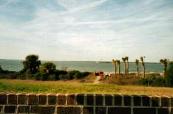
Fort Sumter in distance from Fort Moultrie
Still incomplete in 1860, Fort Sumter was located on a small man-made island in the harbor and could be much more easily defended since any attacking force would have to approach by boat under the guns of the fort. Although the conditions there were much less comfortable than at Fort Moultrie, Anderson made the decision to move his men over.

Led by Anderson in person, the bulk of his force went over to Fort Sumter in boats on the night of December 26, 1860. Left behind were twelve men and a surgeon, commanded by Captain J.G. Foster of the engineers, who were ordered to spike the heavy guns in Fort Moultrie and destroy their carriages. This work was accomplished during the night of the 26th and the fort's flagstaff was also cut down.
To learn more about Fort Moultrie, now a national park area and open to the public daily, please visit www.exploresouthernhistory.com/SCMoultrie1.